


Yellowstone Jack, The Life and Times of Legendary Pioneer Jack Baronett
As our frequent readers know we are fans of Yellowstone National Park and go as often as we can. Recently we learned of a new biography of one of the most colorful characters in the Park. Yellowstone Jack lived at the end of the 19th and beginning of the 20th centuries. He, like so many of us, was an expatriate, adventurer, tour guide, world traveler and community and literal bridge builder, so we thought we’d share his story with our readers, who are kindred spirits.

Jack Baronett (1829–1906), born in Scotland, was an important figure in the history of Yellowstone National Park. In his early life he traveled the world, prospecting and mining in Australia, Africa, China, and Alaska. He traveled to the Yellowstone region in 1864—eight years before the Park was established—to join other early prospectors searching for gold and exploring the geyser basins. His first claim to fame came in 1869 when he and a partner rescued Truman Everts, a lost member of the Washburn Yellowstone expedition who after wandering in the wilderness more than a month with neither horse nor supplies was near death when Jack found him. He fed him melted bear grease to restore his strength and took him back to civilization. After 1872 and the founding of Yellowstone as a National Park, Jack served as early assistant superintendent. He was also a scout for the US Army and one of the founders of the gold mining town of Cooke City, MT. As a notable guide in the park, his patrons included Generals Sherman, Sheridan and Strong, President Chester Arthur, George Bird Grinnell, and Wiliam Henry Jackson. They all used the toll bridge he built which was the first bridge built over the Yellowstone River in 1871. In 1875 Baronett was deputized as a US Marshall, making him the first federal law enforcement officer in the park. He chased horse thieves and protected the area from poachers and outlaws. The book includes a set of campfire stories as told by Jack to impress his tourist visitors. A French traveler name Jules Leclercq spent the night in the cabin near Jack’s Bridge. In his journal he wrote: « Before closing their eyes, these ‘rough people’ told a thousand episodes from the adventurous lives in the nasal accent so characteristic of the Yankee. »
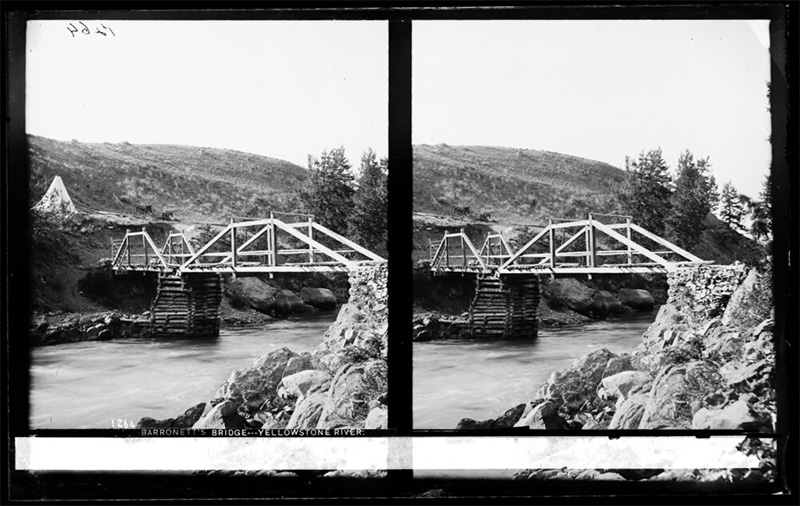
A stereoscope of Baronett’s second Bridge, Read about stereocopes in our article https://fusac.fr/paris-peep-shows/
Yellowstone Jack, The Life and Times of Legendary Pioneer Jack Baronett by Robert V. Goss gives an overview of the history of the Yellowstone area as it was explored and became a tourist attraction. Robert Goss has a good handle on local history having dedicated over thirty-five years to working in and around Yellowstone National Park while living in Gardiner, Montana. Additionally, he served as purchase agent for an underground gold mine at Jardine, Montana, formerly known as Bear Gulch. With this experience, he became familiar with the local mining history, as well as the early chronicles of the Cooke City environs. Goss has self-published seven books that primarily focus on the early concessioners and pioneers. He also authored or co-authored twenty-three articles featured in Yellowstone History Journal, Yellowstone Science, Annals of Wyoming, oints West, Montana Pioneer, and other publications.
The book Yellowstone Jack is available from Riverbend Publishing
Robert Goss’s wonderful Yellowstone history website is called Geyser Bob.

Jack Baronett
For additional history of Yellowstone have a look at superintendent H.M. Chittenden’s book , free to download on Project Gutenberg. « The Yellowstone National Park: Historical and Descriptive » by Hiram Martin Chittenden is a historical account written in the late 19th century. The book provides a comprehensive exploration of Yellowstone National Park, detailing its rich history from the days of early explorers like Lewis and Clark to its designation as a protected area. It aims to document the significance of the park’s natural wonders and the efforts made to preserve them. At the start of the text, Chittenden sets the stage with a preface that recounts the early explorations of the region and highlights the need for government protection of the park’s unique features, which had garnered widespread interest. He shares insights from a 25-year-old exploration journey that underscored the necessity of preserving Yellowstone’s environment. The opening chapters discuss the origins of the name « Yellowstone, » the Native American tribes that inhabited the area, notably the Crows and Blackfeet, and early interactions with explorers and trappers, including John Colter’s significant contributions to understanding the region’s resources and geological features. https://www.gutenberg.org/ebooks/42112