


Inspired by Philippa Campsie’s excellent blog Parisian Fields https://parisianfields.com/ where she talks about her husband’s Paris peep show collection of stereoscopes. I started exploring stereoscope peep shows of Paris and Montana – my two favorite places. I thought I’d share a couple of the images of bridges that I found. But first what is a stereoscope.
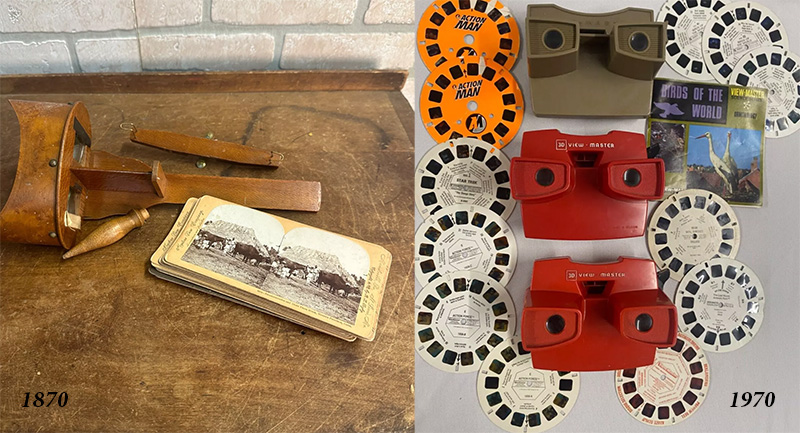
Stereoscope and Viewmaster then and now
Like it sounds there’s stereo (from more than one source) and scope (view). A stereoscope is an optical trick, a dual or double view; the art of capturing and displaying two slightly offset photographs to create three dimensional images. Of course you need a special viewer to see the overlaid images. Remember that Viewmaster you had as a kid? That’s a « modern » stereoscope! I came across a Viewmaster wheel recently in a book which had been donated to Bill & Rosa’s Book Room. What a blast from the past. I had mine when I was about 10. Our family travelled across the USA that year, 1975, in a green Dodge Maxivan. For souvenirs I collected charms for my charm bracelet, which I still have, and Viewmaster wheels which I no longer have. My sister collected souvenir spoons. She claims she still has her Viewmaster, wheels and spoons – somewhere. The Viewmaster made the Grand Canyon, Yosemite and Yellowstone come alive in 3D after we got back home then they went into boxes.
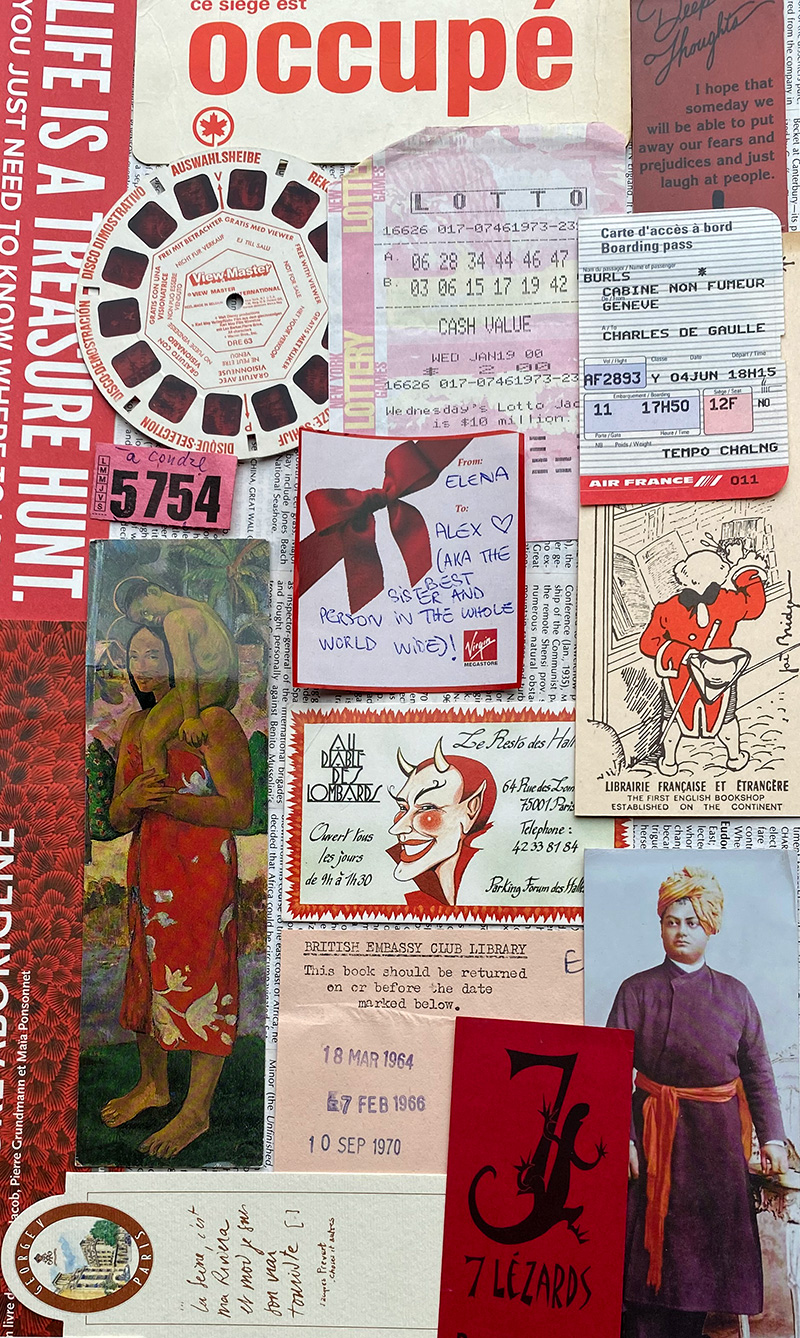
A collage of things found in donated books
So even though stereoscopic images date back to the 1870s, they were still around, and still a novelty in the 1970s. And come to find out not that long ago even Michael Jackson made Viewmaster reels – although by then they also were talking.

The principle of the stereoscopic image is quite simple. Two images ever so slightly different are viewed through each of your two eyes. The 3D effect works because each eye is in a different location, and as a result, it sees a slightly different image. The difference between these images is what lets us perceive depth. Two pictures of the same subject are taken but offset by the same distance as your pupils (about 2.5 inches or 63 mm). The two images are then viewed so that each eye sees only the corresponding picture. Your brain puts the two images together just as it does for normal vision and you perceive a single three dimensional image.
Philippa’s husband, Norman Ball, has has a collection of historic stereoscope images. You can find them in the postcard bins at brocantes. I’ve framed a few for wall decorations. Philippa likes to compare the left and right images and spot the differences. Here are those views of bridges that I promised. The part I find most interesting is the juxtaposition of historic photos in divergeant places from the same time period. Enjoy.

Pont Neuf 1860.

Stereoscope of Paris 1865.
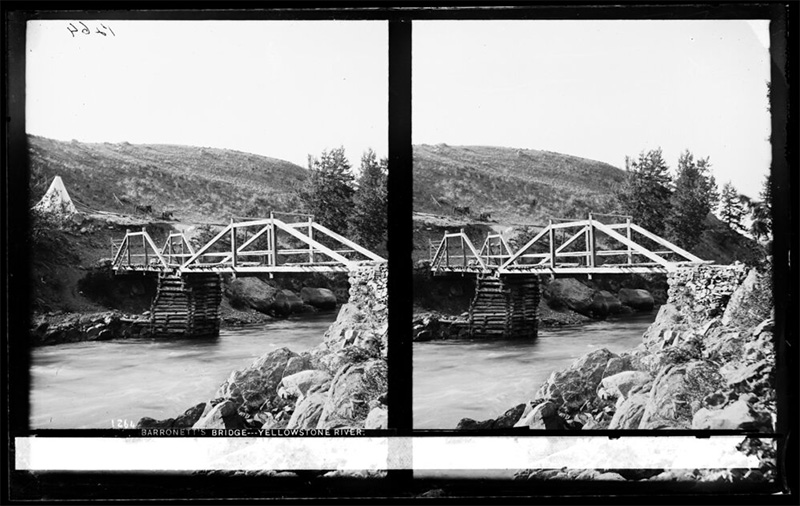
Baronett’s Bridge, Yellowstone River, built 1871. Read about the bridge in our article on Yellowstone Jack
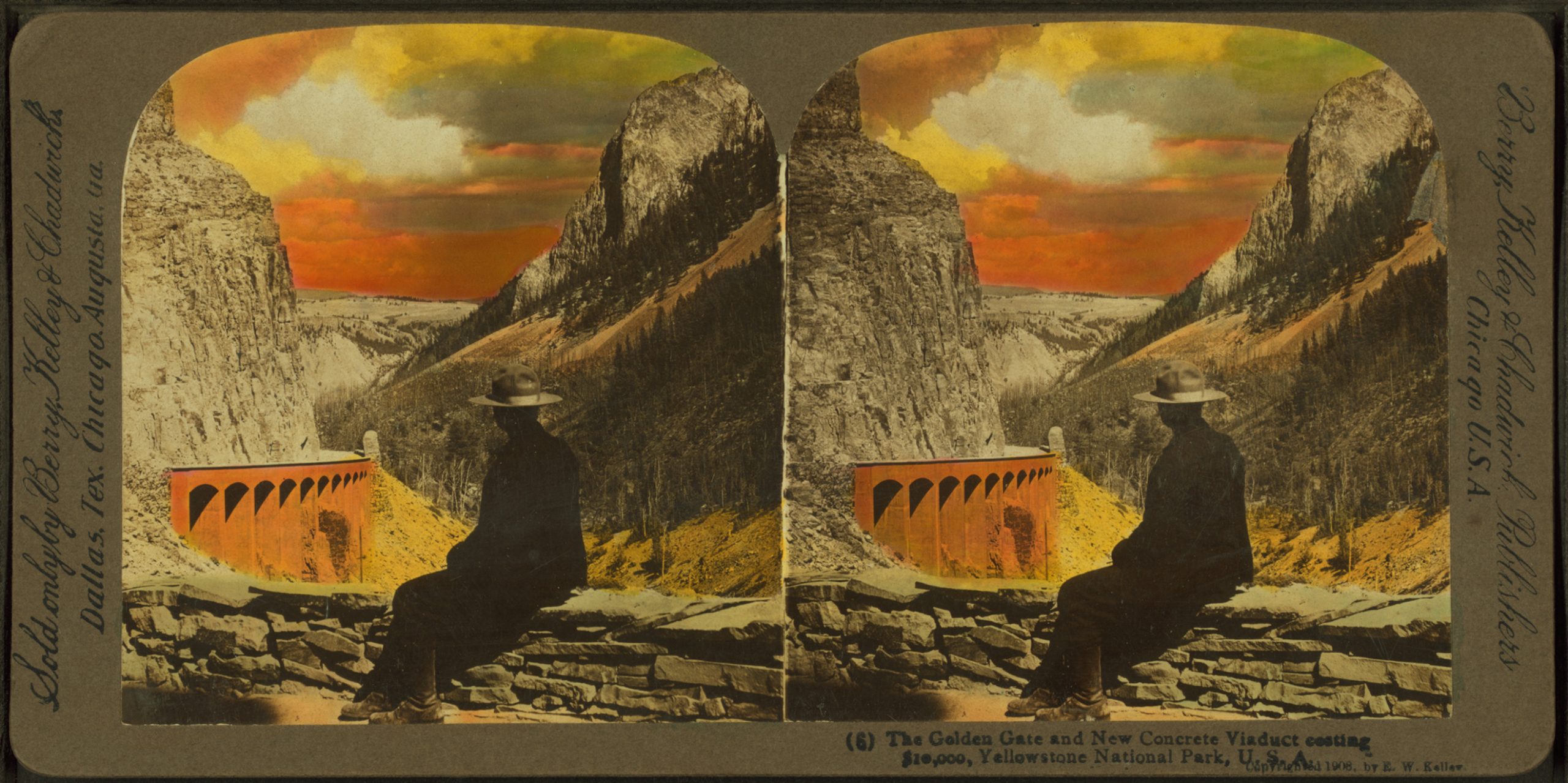
The Golden Gate Viaduc in Yellowstone. The viaduct was hailed as one of the best feats of engineering in the Park. 1901
To learn more about early Paris peep shows enjoy this video that traces the history of the evolution of 3D and moving images.