


Pounds and Ounces, Stones and Gallons: Exploring Their Origins
Pondering Pounds
Have you ever wondered why the abbreviation for pound, both as a unit of weight and as currency, is “lb” or represented as £ (an L with a line through it)? The answer lies in the Latin word “libra.” In astrology, Libra, the seventh sign of the zodiac, is symbolized by scales due to its association with balance, weights, and measurements. In ancient Rome, the standard unit of weight was « libra pondo, » which meant « a pound by weight » in Latin. The English word « pound » is derived from the « pondo » part of this phrase, while the abbreviation “lb.” comes from « libra. » Similarly, the symbol for the British pound (£) also traces its origins to « libra pondo, » as the value of the pound was once equivalent to the price of a pound of silver. Interestingly, other currencies, such as the former Italian lira and the current Turkish lira, also have their roots in « libra. »
Then there is the pound symbol (#), also called the pound sign, number sign, hash mark, or hashtag. It is a typographical symbol seldom used in formal writing but frequently seen in informal contexts as a substitute for the word “number” and of course these days it is mostly used on social media. Though it’s origin goes back to « lb » having been derived from the now-rare symbol ℔ it was first seen on a keyboard of the Blickensderfer model 5 typewriter (c. 1896).
Ounce: abbreviated « oz. »!
The abbreviation « oz. » for ounce, which has no “z” in sight, traces its origins to the Latin word « uncia, » a term used for both Roman units of weight and length. The Normans brought this word to England, where « uncia » became « ounce » in Anglo-Norman French. The abbreviation « oz. » comes from the medieval Italian transformation of « uncia » into « onza, » which introduced the « z » that remains in the English abbreviation today. There are 16 oz in a lb. But also 8 oz in a cup. Egad.
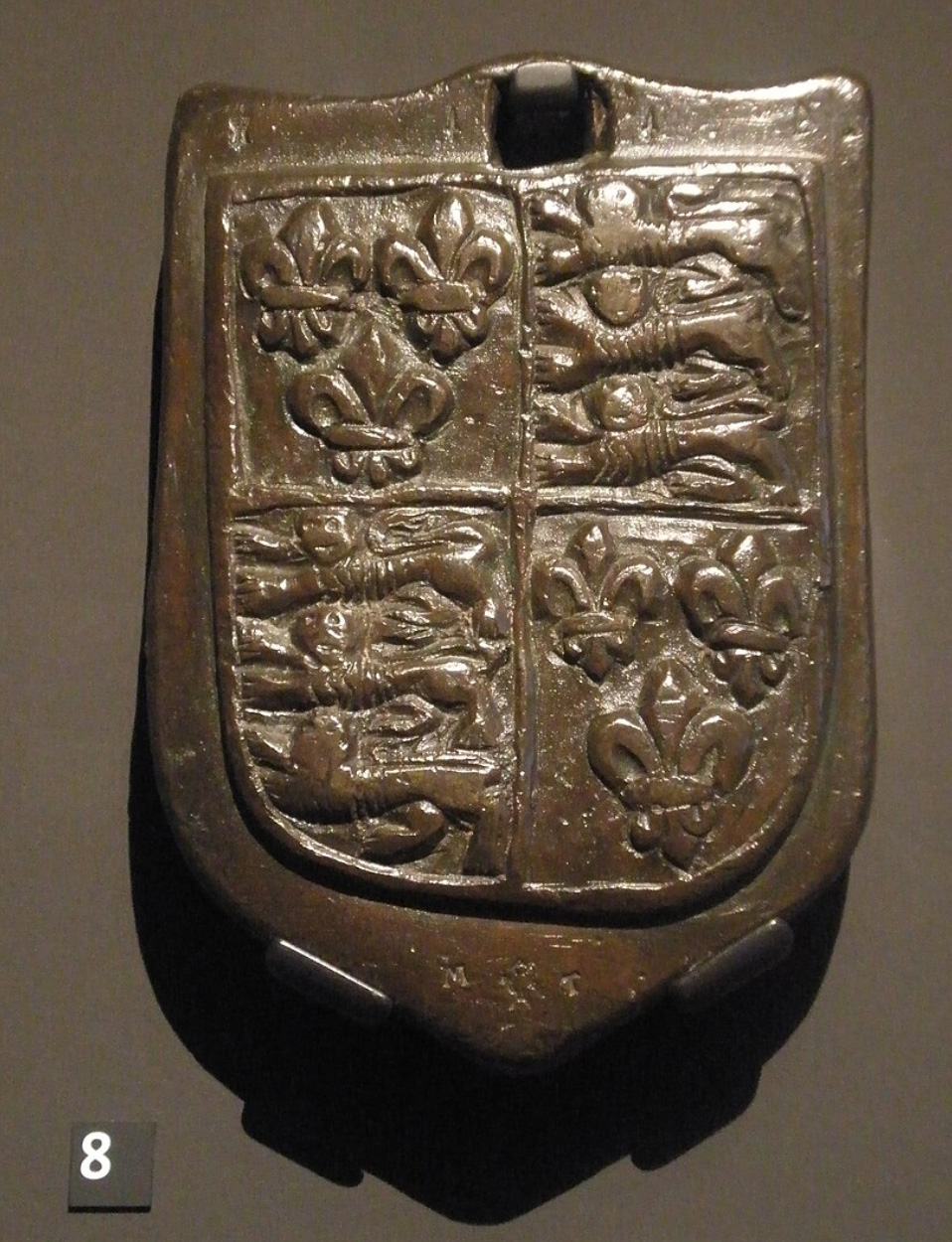
By the middle of the 16th century, England had established itself as a major European producer of woollen cloth. Wool from England was thought to be the finest available. Special decorative weights were used to weigh it. Wool weights had holes or loops with which to attach a leather strap so that they could be slung over a beam and counter-balanced with an equivalent weight of wool. Wool weights were made as 7, 14 and 28 lb weights (i.e., ½-, 1-, and 2-stone weights). This particular weight weighs 14 pounds or 1 stone. Shield-shaped wool weights survive from the reign of Henry VII onwards. This example shows the Royal Arms of England.
Stone: The weighty origin
In Britain, 14 pounds is referred to as a stone, a term that originated from the historical practice of using an actual stone as a local standard weight for trade. By the 14th century, the English stone was standardized by royal statute to be 14 pounds, mainly for the wool trade, and this value was subsequently adopted into the imperial system. The term « stone » as a unit of weight persisted as a carry-over from ancient times when rocks served as measuring tools. The word itself dates back to Old English, predating Norman influence and reflecting Germanic language heritage.
The stone was not always a fixed measure and varied depending on the commodity and location. For example, in London, a stone of beef weighed eight pounds; in Hertfordshire, it was twelve pounds; and in Scotland, it was sixteen pounds. The 1772 edition of the Encyclopædia Britannica documented these variations. The Weights and Measures Act of 1824 consolidated laws across the United Kingdom, finally standardizing these units. Today only people are measured in stones. The most common abbreviation is st.. For example, a person’s weight might be listed as « 10.5 st. » which stands for « 10.5 stone » or 10 stone and 5 pounds.
The Gallon and Standardization
The term « gallon » also exhibited local and commodity-based variations. It originated from the Old French word « galon, » meaning a bucket or mug, and was used in medieval England to measure liquids such as wine and ale. The imperial gallon was later established as part of the effort by the British Empire in the 19th century to standardize weights and measures across its territories, hence the naming of the system to be the “Imperial System of weight and measures”.
The Rise of the Metric System: Merci!
Given the many inconsistencies in traditional weights and measures, the need for standardization became clear. The French Revolution highlighted this necessity, as France faced a confusing array of local measurement systems. In 1790, Charles Maurice de Talleyrand-Périgord proposed a new system based on natural units to the French National Assembly, aiming for worldwide adoption. When the United Kingdom declined to collaborate, keeping their pounds and ounces, the French Academy of Sciences set up a commission to create the metric system independently. In 1799, France officially launched this new system, which provided consistent, logical, and easily calculable weights and measures with intuitive abbreviations. So, raise a pint (a 16 oz. unit of liquid capacity equal to one half of a quart, which is a quarter of a gallon) in celebration of French logic and the consistency it brought to measurements!
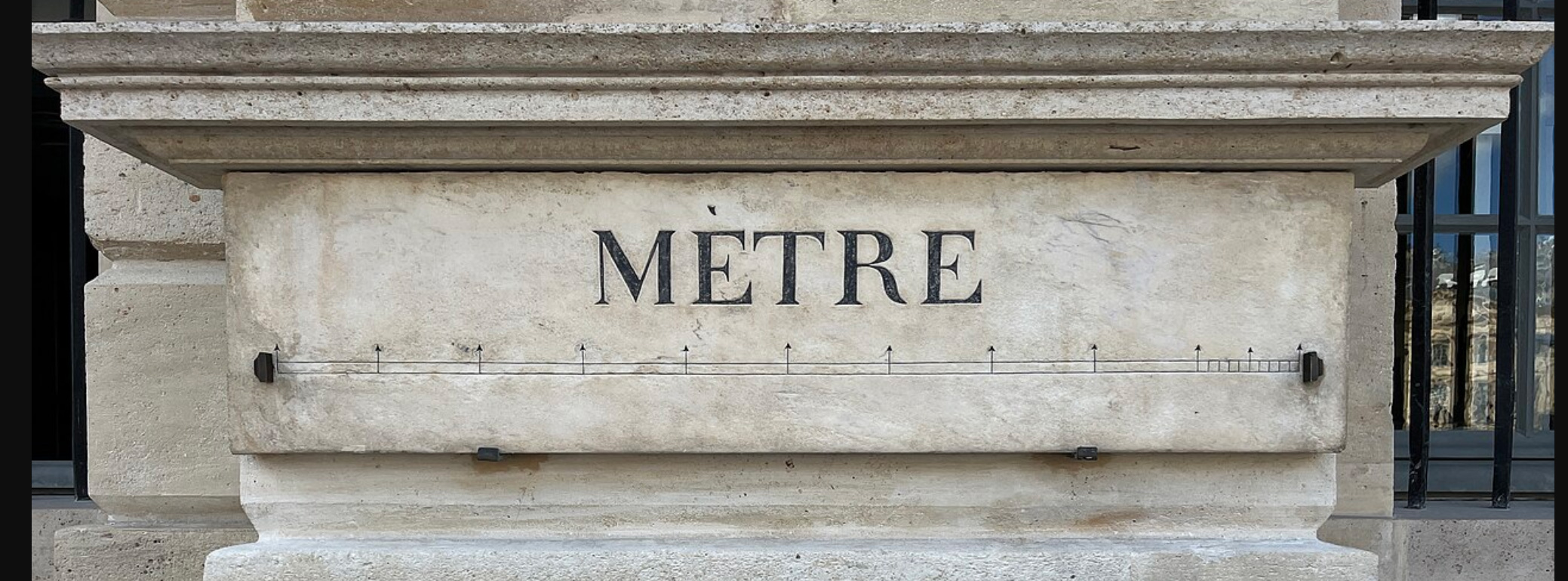
Photo: Creative Commons Attribution-Share Alike 4.0 International license
Visit the METRE ETALON in Paris. A Metre Etalon is the official and standard representation of the the meter. To promote the widespread use of the metric system, the National Convention had sixteen marble measuring rods placed in the most frequented locations in Paris. These rods were installed between February 1796 and December 1797. There are only two remaining in Paris. The one on rue de Vaugirard is the only one still in its original location. Above is the one on place Vendome.

See our other articles about things made or invented in France
#pounds and ounces