


A recounting of a typical Sunday playing pétanque by l’Américaine, Niky Compton, le 9 juillet 1980 à Besançon
C’est aujourd’hui dimanche. Vous rencontrez vos amis dans le parc pour jouer à la pétanque. Vous apportez avec vous la petite boule qui s’appelle le cochonnet, et deux grandes boules lourdes.
- Saluez vos copains en leur serrant la main. Les Français se donnent un coup de main pour saluer même les bons amis tandis que dans une telle situation décontractée, les Américains diraient simplement « Hi! » aux copains.
- Divisez-vous en deux équipes de deux personnes.
- Mettez-vous d’accord sur les limites du terrain de boules.
- Marquez avec le pied une ligne au sol.
- Prenez vos places derrière la ligne.
- Lancez le cochonnet.
- Lancez (à tour de rôle) une boule vers le cochonnet.
- Votre boule est la plus proche au cochonnet et alors, c’est vous qui commencez.
- Allez ramasser votre boule et reprenez votre place derrière la ligne.
- Lancez-la encore une fois vers le cochonnet.
- Regardez les efforts des trois autres joueurs.
- Criez « Zut » La boule de votre adversaire a frappé la vôtre et l’a jetée plus loin du cochonnet.
- Lancez votre deuxième boule.
- Sautez en l’air avec joie. Votre boule touche au cochonnet.
- Dites « Bravo! » Personne n’est plus proche au cochonnet que vous. Votre équipe a gagné!
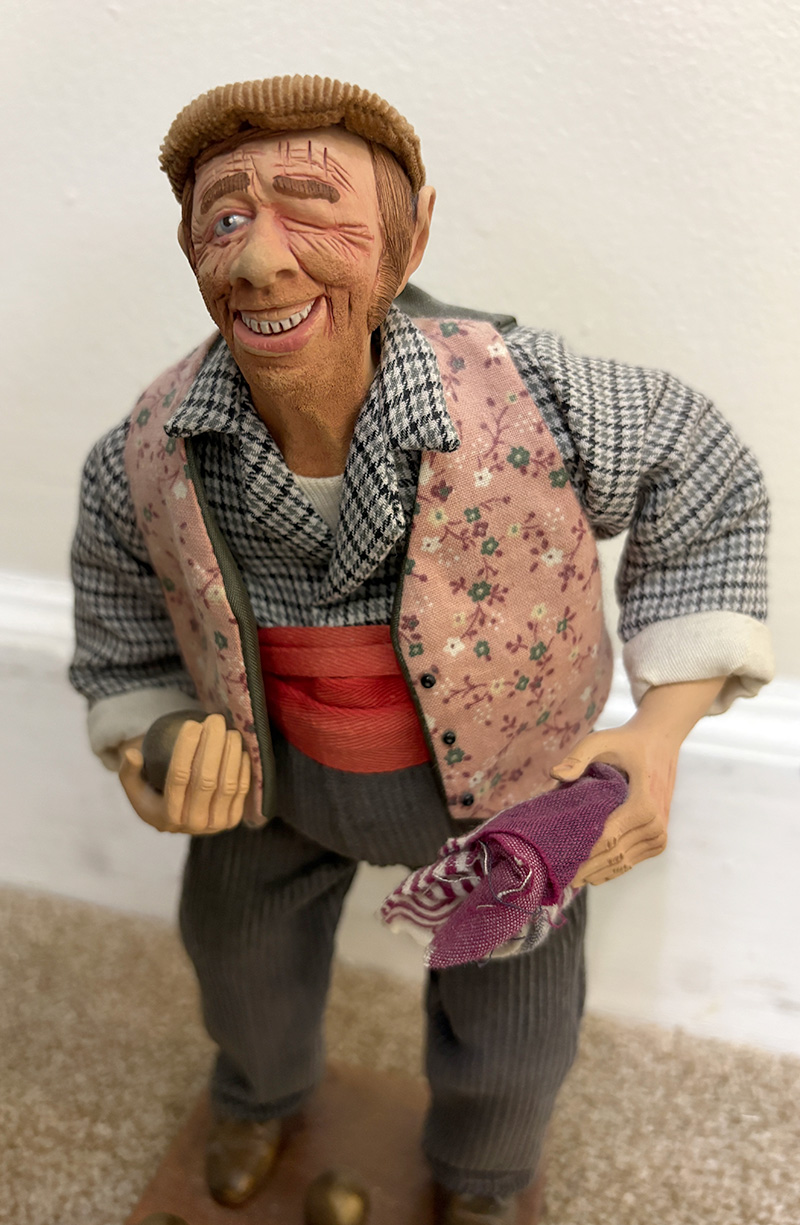
« Le Bouliste » Santon de Provence that my mother adores
Pétanque (from Provençal: pèd, « feet », and tanca, « planted ») is « the game with feet planted » a boules game derived from the French Provençal game. It is the eleventh most popular sport in France. The Fédération Française de Pétanque et Jeu Provençal (FFPJP) has over 300,000 licensed members and there are nearly 3 million regular casual players in France. Pétanque is so important to French culture that it is part of The National Inventory of Intangible Cultural Heritage.
In pétanque, the objective is to score points by positioning your ball closer to the target ball than those of the opponent. You point or shoot! This is achieved by throwing or rolling balls closer to the small target ball cochonnet, (officially called a jack in English). This is called pointing. Or by hitting the opponents’ boules away from the cochonnet. This is called shooting. Throws are made while standing inside a circle with both feet on the ground. The game is usually played on hard dirt or gravel. It can be played in public areas in parks or in dedicated facilities called boulodromes.

Ready to point or shoot – Luxembourg Gardens
History of Pétanque
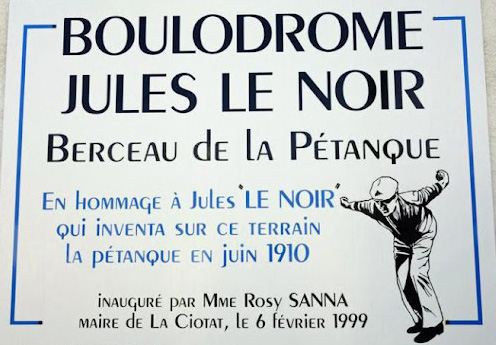
Though the current form of the game was codified in 1907 or 1910 in La Ciotat (Marseilles), in Provence, France. The game of boules is believed to have originated during the conquest of Gaul. The boules were initially made of clay, then stone, then wood, and finally steel after World War I when round shot manufacturing technology was adapted to allow the manufacture of hollow, all-metal boules. The golden age of boules of all kinds was the Renaissance, when the nobility embraced the game alongside cup-and-ball and jeu de paume which would later become tennis. For obscure reasons, the game was forbidden to the common people in 1629. In the 18th century, the game remained very popular, to the point that Diderot and D’Alembert’s Encyclopedia mentioned it. The French Revolution, by abolishing the privileges of the nobility, legalized the game once again for everyone.
In the second half of the 19th century, a version of boules known as jeu provençal or boule lyonnaise was very popular. Players ran three steps before throwing the ball. Jules Lenoir, a jeu provençal champion player, suffered from rheumatism so that he could no longer run before throwing. A good friend named Ernest Pitiot developed a variant form of the game in which the length of the pitch or field was reduced by roughly half, and a player, instead of running, stood in a circle. They called the game pieds tanqués, « feet planted » (on the ground), a name that eventually evolved into the game’s current name, pétanque.
Pétanque is not widely played in the Americas. There is a Canadian pétanque federation based in Québec. In the United States, the Federation of Pétanque USA (FPUSA) reports that about 30,000 play nationwide. Horseshoes and corn hole are similar “picnic sports”. When they do play with balls Americans frequently use the Italian term « bocce » [rhymes with cooking on a hibachi]. Both Pétanque and bocce are boules sports which could also be described as lawn bowling. The two games are very similar in nature and rules, so it is easy to confuse one with the other. The differences are in the size of the teams, the size of the terrain, and the throwing style.
| Pétanque | French | teams of 1-6 | Official terrain
50 feet long |
smaller ball,
70-80mm |
throw with palm down for spin |
| Bocce | Italian | teams of up to 8 | Official terrain
91 feet long |
larger ball,
90-114mm |
throw with palm up for force |
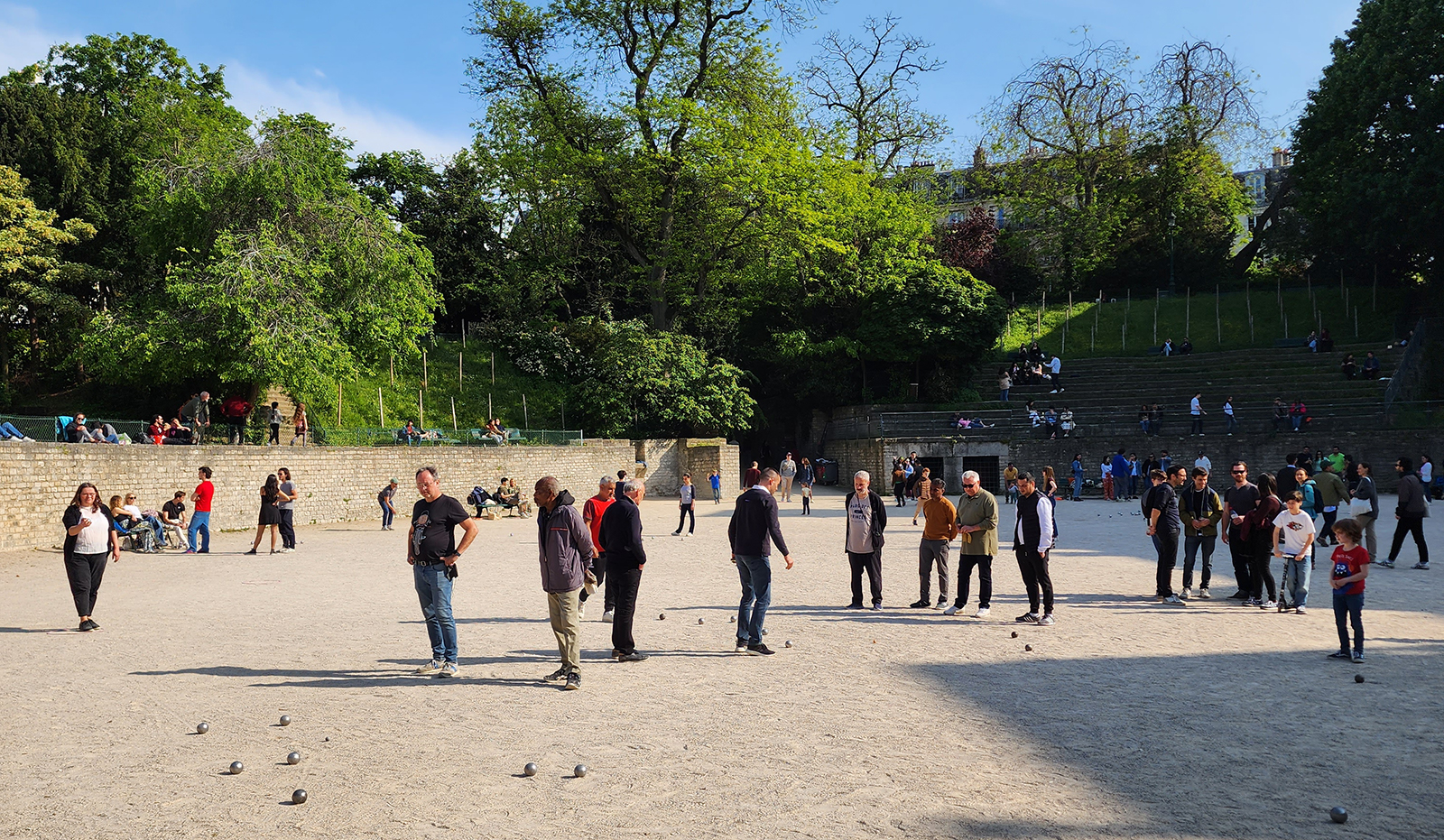
Pétanque in Les Arènes de Lutèce in Paris