


Following up on our article in which we presented three American cultural icons that in fact were French creations we now turn to Maigret and Columbo, two famous detectives of book and film. Was the American Columbo inspired from French Maigret? Well, Maigret certainly came first in time and Columbo certainly shares quite a few of his characteristics plus he has a French car!
The son of Georges Simenon, the author of the Maigret series, says that because his father wouldn’t sell the rights for Maigret, Columbo was created as a different character but inspired by the famous Maigret. Maybe that’s why Columbo drives a Peugeot that winks back towards Maigret and Paris.
John Simenon is quoted in 2016 :
« Les explications d’Alain Sachs, qui a interprété Le Petit Docteur [another Maigret character] à la télévision française, sont peut-être un peu approximatives, mais c’est bien à la suite d’un refus de mon père de céder les droits du personnage du Petit Docteur, comme de Maigret d’ailleurs, que Columbo a vu le jour. »

Let’s look at a few of the similarities and differences of Maigret and Columbo.
What I like about Maigret and Columbo is that you get the old-style methods of investigation: newspapers, telephones, going door to door, from tailor to tailor with a button in hand, interviewing and asking questions and research by flipping through stacks photos using the technology and manual methods of their earlier time periods.
Maigret and Columbo are shrewd and exceptionally observant homicide detectives who often disguise their aptitude. Columbo with his inelegant, shambling, chatty manner and blue-collar ethos and head scratching. His famous catchphrases are
- « Just one more thing. »
- « There’s something that bothers me. »
The people Columbo interviews during his investigations, especially the suspects, often become irritated with Columbo’s habit of taking an inordinate amount of time to get to his point. This causes the murder suspects to be dismissive of Columbo as he builds his case against them. He also pretends to be in awe of their wealthy lifestyles.
Another motif common to both Maigret and Columbo are investigatory tactics with the murderer. Columbo often asks a series of questions which the killer easily answers, or explains, seemingly ending the conversation, only to have Columbo bring up « just one more thing » before asking a final question or presenting a scenario that unsettles or stumps. In most episodes, Columbo confronts his suspects at inconvenient times, resulting in their irritation with him. This, combined with his probing questions, exasperates the suspects, who typically try to answer Columbo rather than remaining silent and seeking counsel. This often leads to the suspects either directly, or indirectly, incriminating themselves.
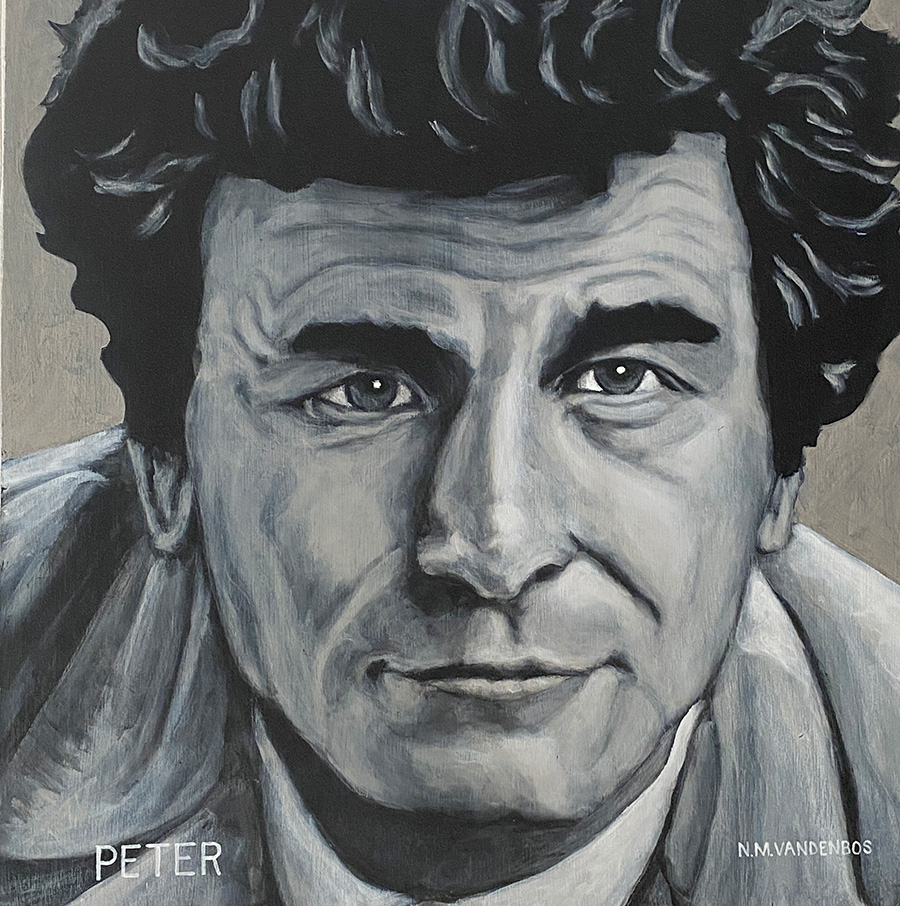
Peter Falk as Columbo by Nate Vanden Bos
Maigret also never loses his plebeian appearance: he thus deceives the vigilance of the most suspicious and easily collects confessions, opinions and gossip, because he knows how to listen. Instead of limiting himself to conducting a series of close interrogations with suspects, he prefers to hear how each person regards himself. In Maigret Lays a Trap he calmly asks a suspect to show him the suits in his closet, looking for one with a lost button. Maigret is a simple, even ordinary, man. He can be grumpy, even sullen, especially when his investigation gives him the impression that he is not making progress. As a simple man, he can be uncomfortable in circles favored by birth or wealth as is Columbo.
Both characters rarely display anger and often seem to like or be sympathetic towards their suspects. Neither character carries a gun and is never shown to exercise physical force. Columbo is (or pretends to be) squeamish and does not like hospitals or autopsies. Nothing makes Maigret flinch.
Both are placid, methodical and simply work through a case by rethinking, asking more questions and gradulally putting the pieces together. Nothing comical, although Columbo often appears comical because he plays stupid. Both are guided by instinct and use casual investigative methods, sometimes taking on a « stupid air » to deceive suspects, a similar method of immersion in an environment.
Simenon describes Maigret’s physique which is anything but “maigre”:
“He was huge and bony. Hard muscles bulged beneath his jacket, quickly stretching his newest trousers. Above all, he had a way of standing out that had not failed to displease many of his colleagues themselves. It was more than self-confidence, yet it was not pride.»
Columbo on the other hand does not exhibit muscle and is rather short.

A bronze sculptural work with life-sized statues of Columbo and Dog by the sculptor Géza Dezső Fekete was erected in Budapest in Falk Miksa utca (Miksa Falk Street, Miksa is another Falk from the 19th century).
Props and attributes
Smoking materials: Columbo chews on his cigar and Maigret on his pipe, both ever-present tools that help them think. Columbo has his basset hound named « Dog » and the old barely running Peugeot as additional endearing elements. Columbo claims he is always nervous when he is in the passenger seat rather than driving. Maigret doesn’t drive. He walks, rides in taxis, takes the bus (impossible in Columbo’s expansive Los Angeles) or is driven in a police car by one of his inspectors.
The anecdote about the Peugeot is the following. A few days before filming the episode The Witness Book, in 1971, the production team still had to find the lieutenant’s car. Peter Falk himself visited the Universal Garages. After walking up and down the garage’s aisles, he stopped in front of a beat-up Peugeot 403 convertible. It was love at first sight. Peter Falk later explained: « There were only Fords, Chevrolets, and Buicks, all of which looked the same. I didn’t know this car, I didn’t even know it was French. » Any yet it fits perfectly with a nod towards Maigret.

Image: https://www.flickr.comphotosharry_nl25026482698
The rain or trench-coat: each Maigret story gives you a tour of grey raining Paris whereas Columbo is set in sunny SoCal and yet both wear trench-coats. When Columbo gets a new raincoat as a birthday gift from his wife in the episode Now You See Him. Columbo says that he « can’t think » in this coat and desperately tries to lose it. As for hats, Maigret wears a bowler to start. Later for both detectives it’s a fedora.
Columbo’s trademark outfit of the rumpled raincoat over a tan suit and green tie never varies from case to case or year to year even on vacation, except when he must fit into the milieu at a party and dons a tux. Maigret’s outfit is strikingly simple and similar, but with suspenders.
Notebooks: Maigret takes notes in a pocket-sized, ten-cent notebook with graph paper and an oilcloth cover. Columbo has the same but with plain paper.

« One of the greatest writers of the twentieth century ». — Guardian
The wives
Both of the wives of Maigret and Columbo are mentioned in the background but rarely or never seen (with the exception of the title Mme Maigret’s Friend). However, both frequently mention the Misses. In a number of Columbo episodes, the murderer is a celebrity, and he attempts to procure an autograph for his wife. In the episode Short Fuse, the Lieutenant recounts that his wife believes he’s the second-best cop in the LAPD – behind 80 other guys tied for first (again he denigrates himself). Mme Maigret, whose first name is Louise, on the other hand, keeps a scrapbook of clippings from newspapers that talk about her celebrity husband. Maigret is a Paris legend, and she is proud of him, although she wishes he would retire.
Hobbies
Columbo reveals his love of classical music and in one episode, in another claims that he is a big fan of western (i.e., cowboy) movies, whereas Maigret likes cinema in general and often takes Madame Maigret to the show.

Explore Maigret’s Paris: A Literary Guide to the Streets, Landmarks, and Mysteries of Georges Simenon’s Detective https://www.herblester.com/
Both characters are integral parts of their city (LA and Paris) police force. Both worked their way up through the ranks and have earned their supervisory positions. Maigret clearly supervises a large team in the beehive of the quai des Orfèvres. He has lots of resources to carry out detective investigations and different helpers including the juge d’instruction. Both involve younger detectives in their investigations and usually find some reason to praise them.
Time period
The character Columbo was created for « Enough Rope », a 1960 episode of The Chevy Mystery Show, a TV anthology series. The television and most famous version of Columbo aired over 69 episodes from 1972 to 1990. Maigret was written from 1931 to 1972 for a total of 75 books and 28 short stories.
Travel
Columbo investigates in London, Mexico and Paris and vacations on a cruise ship in Mexico.
Maigret goes to New York, Holland, Belgium and many regions of France, Switzerland. His Vacation is in Les Sables d’Olonne on the Atlantic coast of France. Both can’t help themselves but to continually investigate even while on vacation.
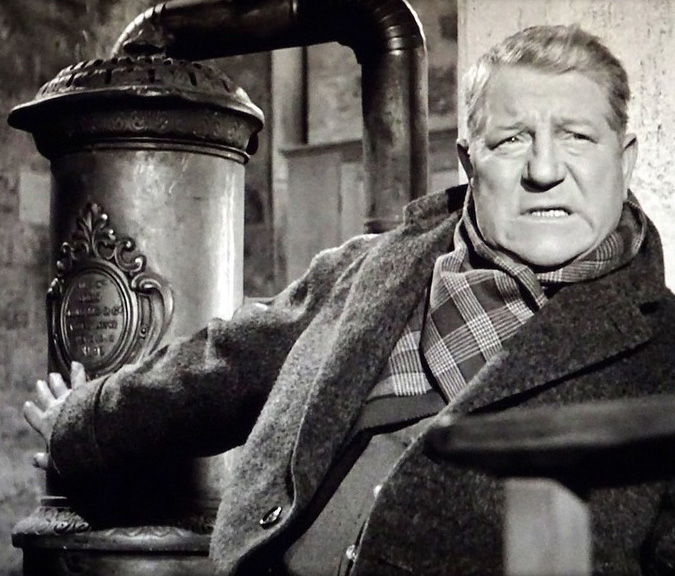
Jean Gabin incarnates Maigret in « L’Affaire Saint Fiacre »
Food and alcohol
Maigret’s favorite dinner is a blanquette de veau prepared by Mme Maigret. Maigret spends a lot of time in cafés where he meets with suspects and receives phone calls. There’s a lot of alcohol consumed. Even at the quai des Orfevres they order beer and sandwiches from the café downstairs on a long day of work.
On the other hand, Columbo often has a hard-boiled egg and a salt shaker in his pocket! His suspects drink quite a bit but we never see Columbo touch a glass of alcohol.
What’s different between Maigret and Columbo is that Columbo always plays the role of the dumb and very pesky inspector, to the point of being comical and then turns the tables on his suspect. In a Columbo story you know who the perpetrator is from the start with Maigret you have to wait for the usually very complicated dénouement.

More Maigret and Columbo Tidbits
- The first episode of the first series of Columbo was directed by Steven Spielberg.
- In a 2001 poll conducted by Channel 4 in the UK, Columbo was ranked 18th on their list of the 100 Greatest TV Characters.
- Columbo’s first name was never used in dialogue, although the name « Frank Columbo » is visible on pieces of identification in various episodes. When asked what Columbo’s first name was, Falk jokingly replied « Lieutenant. » Maigret’s first name was Jules and it too does not appear in dialogue except from Mme Maigret.
- In almost every episode of the later ABC series, Columbo is heard whistling the children’s song « This Old Man« . It often appears as a motif in the musical score and is considered an unofficial title score. The song was first included when Falk stood around in character, whistling the tune without it being in the script and was later considered so fitting for the character that the series used it in almost every episode.
- The French use the nickname “poulet” for the police. One etymology of this is that on the Quai des Orfevres there was a poultry market and rotisseries. Another version mentions that Jules Ferry temporarily assigned the Cité barracks (which are still the headquarters) to the police prefect following a fire, these barracks having been built on the site of the old poultry market in Paris, hence the expression « Poulaga house » to designate 36, quai des Orfèvres.
- The asteroid (293383) Maigret, discovered in 2007, is named in honor of the character.
- For one more French detective spoof check out Steve Martin’s portrayal of Inspector Clouseau in The Pink Panther.
- Madame Maigret’s Friend was published in 1950 by Presses de la Cité. This novel was written in 1949 in Carmel-by-the-Sea, California, as were many of Simenon’s books, some 8,900 km from Paris, but ironically just 492km from Columbo’s Los Angeles.
- Georges Simenon was born in Liege where there is a statue of him on Place Maigret. A second statue of Maigret from 1966 by Pieter d’Hont in Delfzijl is in the Netherlands. Where Georges Simenon set the plot of the investigation A Crime in Holland
- Columbo may be inspired from Maigret, but Maigret is in turn inspired from a real detective named commissaire Marcel Guillaume, nicknamed L’As de la PJ [police judiciaire] that you can learn about at the Musée de la Préfecture de Police.

A bit of British humor. Maigret de canard