


City of Light [and Lampshades]
We are so used to electric power and having light at our fingertips that we forget that it is just a century old. In 1925 only half of all US and British homes had electricity. People used to fear going out on the dark streets at night. The streets were pitch black before the use of gas lamps, offering criminals and cutthroats dense cover. Carrying a flaming torch or navigation by moonlight wasn’t too practical.
The earliest portable lights were candles. Candle makers produced thousands of candles from tallow, beeswax or whatever else would burn for a few hours. Matchmakers were hard at work too. Households, churches, businesses, and public buildings relied on their products every evening after sunset. Public lighting by candle required a lamplighter to tour the town with a ladder in tow at dusk, lighting each of the lamps. Of course, when the lamps went out, the darkness was deep. It was common practice up through the mid-17th century for people needing to go out at night to hire a lantern bearer.
Next there were gas lamps and the lamplighter still made his rounds twice a day to turn on at dusk and then turn off at dawn. Edgar Allen Poe wrote about the dark streets of Baltimore in the early 1830s. The city’s atmosphere, characterized by its dark streets and alleys, inspired many of his macabre themes. One notable line is from a poem that describes the streets of Baltimore as filled with « shadows that are neither men nor women nor beasts. »
Fiat Lux from the Sun King
In the 17th century many places were still in the dark, however in Paris already in 1667 things were less murky. Louis XIV authorized sweeping reforms including the installation of lights on streets and intersections. There were stiff penalties for vandalizing or stealing the fixtures. It was the tinsmiths who began manufacturing a more elaborate oil lamp, called the Cardan lamp. This lamp was topped with a conical metal shade, the precursor to the lampshade we know today.
Paris had more than 2700 streetlights by the end of the 17th century and twice as many by 1730. An improved oil lantern called the réverbère was introduced in 1745. The light from the réverbère (the French word for reverberate) was so much brighter that some people complained of glare.
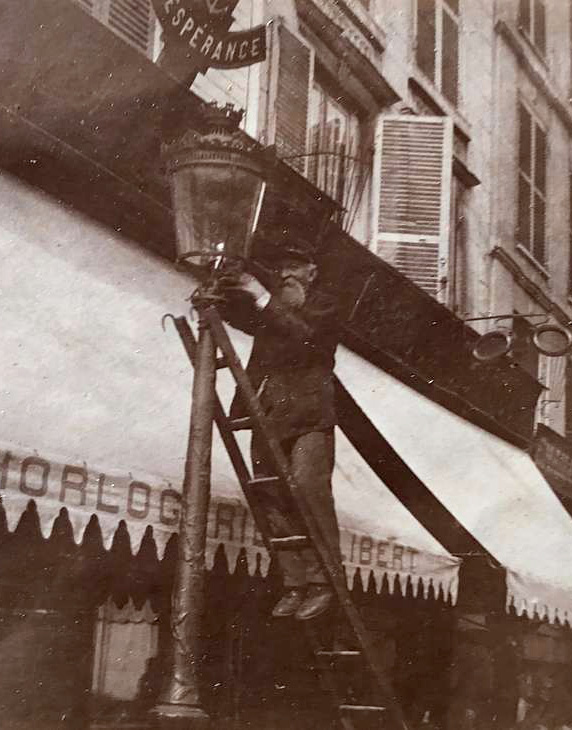
Allumeur des révérberes. Public Domain.
Enter the Lampshade
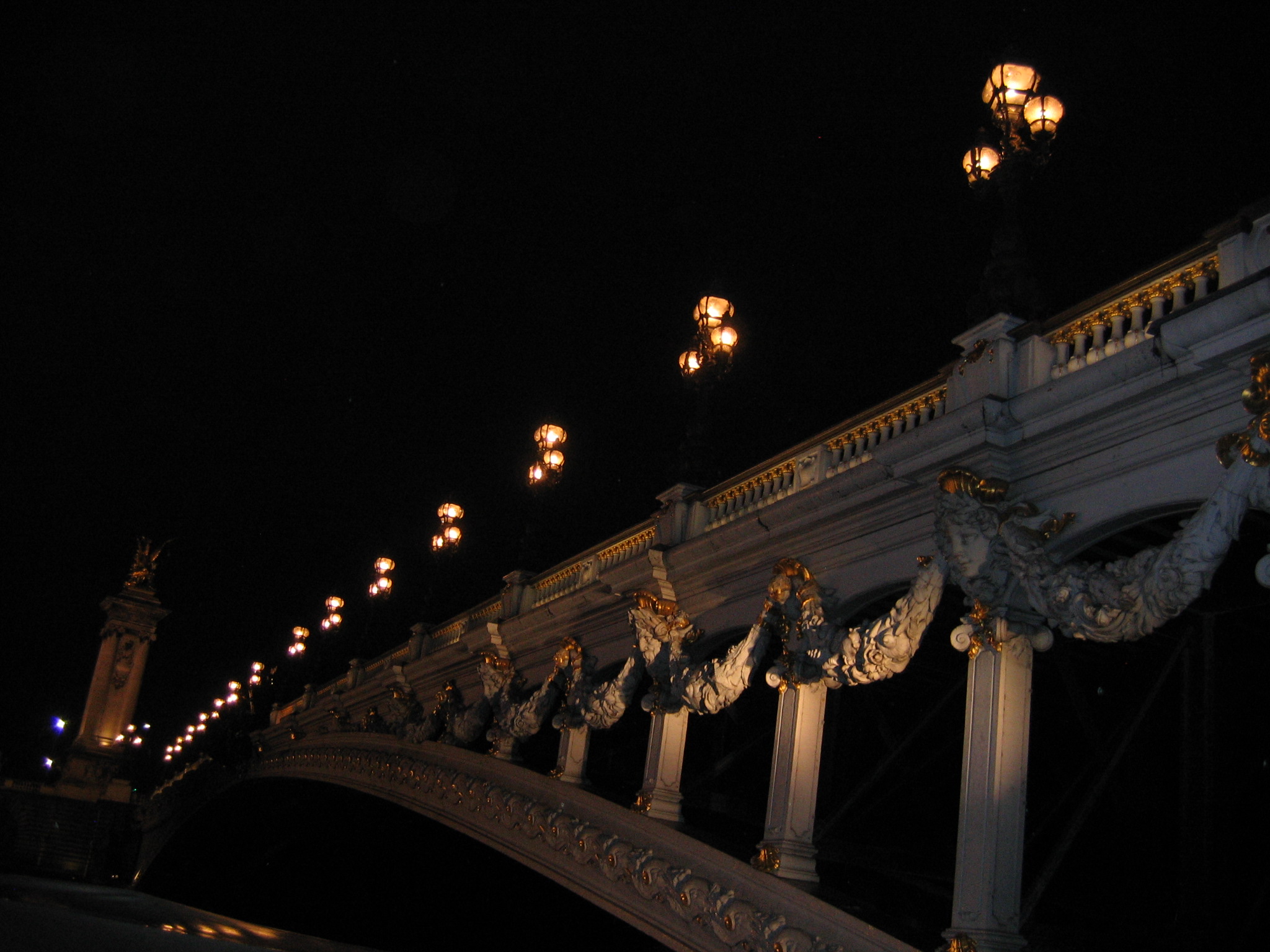
The first lampshades were strictly utilitarian. The idea was not to soften and disperse light in a pleasant way, but to increase light on very dark and dangerous streets. It was on the streets of 17th century Paris, that lampshades came first into wide use to direct light. Standing tall to illuminate the night, these oil burning fixtures distributed light through their glass shades. A dome shaped glass reflector at the top of each fixture would direct light beams downward. Another reflector below the light source- this one slightly concave -would send the light outward. The amount of output from these lights was impressive. In 1878, the Place de la Concorde featured magnificent, highly ornate rostri lampposts (colonnes rostrales) designed by architect Jacques Ignace Hittorff. These iconic streetlamps with glass shades are still in place. No wonder Paris became known as the City of Light [and lampshades].
Moving inside, French speakers lead the way
Gas lights were much brighter than candles or oil lamps and were soon appearing in homes, streets, and public buildings. And the gas lamp revolution led to a lampshade revolution, with glass globes or shades protecting the flame (and eyes) and acting as light diffusers. Once used inside the lampshade was a reflector that directed the light and protected eyes. It was in fact called a light screen or eye shield. This word was used throughout the 19th century.
The Frenchman Antoine-Arnoult Quinquet copied an invention by the Swiss Pierre-François-Amédée Argand and lent it his name—the « Quinquet lamp »—which featured a shade made of painted sheet metal or porcelain resting on a metal framework.
These shields came in various forms—conical or flat—and materials, such as metal, paper, or porcelain. They might consist of an ornate panel mounted on a sliding rod or be clipped directly onto the candle and folded away into a case when not in use. They could also be stationary, placed in front of the candlestick for decorative effect. This period in the City of Light [and Lampshades] saw the rise of lampshades made from painted or printed cardboard, as well as fabric, featuring shapes heavily inspired by the women’s fashions of the day. Their function was no longer to direct the light downward, but rather to diffuse and soften it. Useful but also decorative. By the mid-19th century, decorative lampshades were becoming increasingly popular. Those who could afford them opted for materials like silk and lace, and shades often featured intricate designs and embellishments.
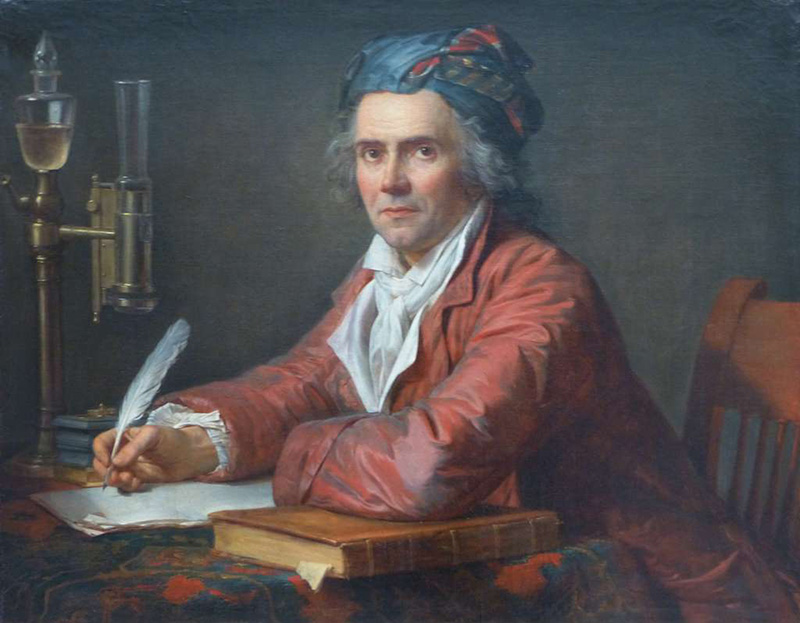
Painting of Alphonse – Louis Leroy, famous gynecologist, who cared for the wife of Jacques-Louis David, who is the author of this painting, note the Quinquet lamp with the shade that slides up and down. Public Domain.
After the lightbulb
With the Edison invention, in 1879, the filaments, sealed inside electric lightbulbs were fashioned. The strong burning bulb now required a shade to shield eyes from direct glare and to diffuse the light. They were usually made of parchment or thin fabric, glass or metal. Simplifying lighting systems removed the final barriers to the creativity of lamp and lampshade designers. They emerged adorned with intricate designs, beguiling combinations of luxurious materials, beads, delicate lace, and graceful fringe, offering the opportunity for refined adornments with a distinct purpose.
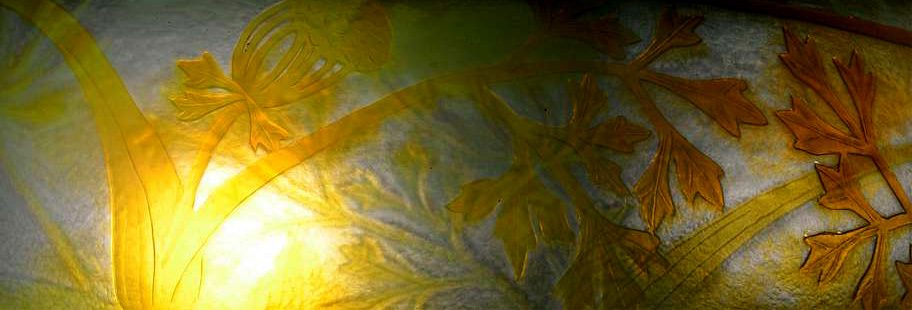
Two art and design movements of this period had a major influence on lampshade design: the natural forms and motifs of Art Nouveau, followed by the geometric shapes and strong colors that typified Art Deco. Some of the most famous lamps of the 19th century were created by French designers such as Daum, Majorelle, Gallé and Lalique offering stained and molded glass with intricate, colorful designs.
As the 20th century progressed, a shift was taking place in people’s design preferences — Modernism had taken hold and its influence could be seen in all aspects of interior design, including lampshades and lighting. It was a case of out with the ornate and in with the streamlined and functional. Lampshades began to be made of modern materials like fiberglass, metal and plastic and styles became simpler. And this shift in taste and the use of new materials supported mass production, with designer lighting and lampshades becoming more affordable and widely available, not to mention very creative.
Coming full circle after centuries of chasing the darkness, today there are movements to bring back the night sky. Flagstaff, Arizona was the first DarkSky community in 1999. The idea is to turn off exterior lights and to focus light downward so as to avoid skyglow light pollution which affects migrating birds and other nocturnal animals. Flagstaff remains safely lit by using amber lighting for roadways and parking lots. They shield exterior lights with lampshades and limit the lighting on non-residential properties.
Read more about the history of the City of Light [and Lampshades]
Read our previous article about Bicycle Lighting