

Wanted : your memories of FUSAC magazine 1988 – 2014
|
|
Wanted : your memories of FUSAC magazine 1988 - 2014
Détails de l'annonce
Rue: 42 rue du Chemin Vert
Code Postal: 92100
Ville: Boulogne Billancourt
Pays: France
Send us your memories ! 2028 marks Fusac’s forty years as one of the most important anglophone lifelines in Paris. Quelle aventure ! Des souvenirs inoubliables !
We’re putting together a book for the occasion and would like to hear from you about your experience reading and using Fusac and how it changed your Parisian life.
Here’s a resumé to jog your memories.
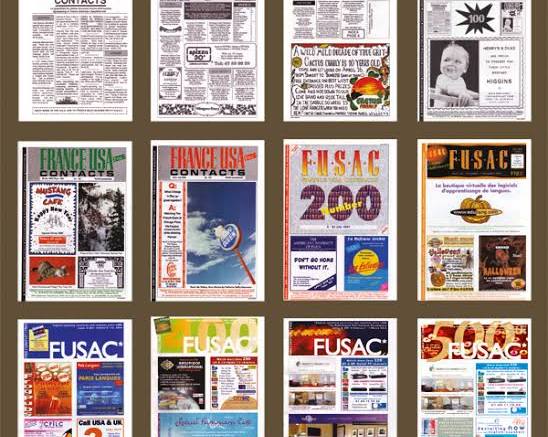
For many expats in France, memories of reading FUSAC (France USA Contacts) are synonymous with the pre-internet era of navigating life in Paris. Since its launch in 1988, the magazine served as the « offline » lifeline for the English-speaking community.
Core Memories of the FUSAC paper version
- The « Expat Bible »: Before digital platforms, FUSAC was the primary source for finding housing, English-speaking jobs (often nannying or teaching or restaurant work), used furniture and household items of all sorts, friends, service providers such as plumbers and electricians, and everything else under the sun.
- Physical Rituals: Readers remember picking up free copies at English-language bookstores, cafes, or the American Church in Paris. The magazine produced over 20 million copies across 523 print issues during its 26-year run. That comes to 9617 days or 316 months or 1373 weeks that Fusac loomed over the anglophone landscape of Paris and France.
- Friendship & Romance: The classifieds were famous for « friendship ads. » At least four marriages are known to have resulted from connections made through FUSAC ads in the 1990s.
- Cultural Benchmarking: A popular feature, « 90+ Ways You Know You’re Becoming French » by Shari Leslie Segall, became a cultural touchstone. It allowed expats to measure their integration through humorous observations and was later published as a standalone book.
-
The « Speak Easy Puzzle » was a flagship feature in FUSAC magazine Created by the publication’s founders for the expat and bilingual community in Paris, this linguistic game offered a fun, visual way to master idiomatic expressions in both French and English. The feature presented readers with illustrated word-and-picture puzzles based on colorful cultural idioms. The main goal was to help learners –be they French natives or native anglophones — to bridge the cultural gap and become truly bilingual. It became incredibly popular among expats, language students, and teachers. In fact, readers frequently clipped the pages out of the magazine to save them. It was nuts ! C’était complètement marteau!Modern Evolution
While the print magazine ended in 2014, the brand continues to hold a place in the community:
- Online Presence: The FUSAC website still hosts classified ads, articles, and puzzles.
- Bill & Rosa’s Book Room: The founders, Lisa and John Vanden Bos, transitioned into running a physical space called Bill & Rosa’s Book Room in Boulogne-Billancourt, which serves as a hub for used English books and community gatherings.
- Pop Culture Legacy: Its importance was even immortalized in literature, such as the 2021 novel Em’s Awful Good Fortune, where the protagonist finds a therapist through FUSAC.
-
In the 2003 film Love Actually, FUSAC makes a notable cameo that anchors a key romantic storyline in reality.
During the final act, the character Jamie (played by Colin Firth) returns to France to find Aurélia. Upon landing at the Marseille airport, he is seen getting into a taxi while holding a copy of FUSAC. -
In 2000 French journalist Jean-Paul Jody wrote the novel Stringer, published by Editions Babel. FUSAC was mentioned in the novel on page 16 as the main character was seaching for an apartment in Paris:
« …Trois étages plus haut, la chaudière de mon cerveau bouillonnait. J’ai repris mes esprits avant de sonner. Des pas légers ont glissé jusqu’à la porte et se sont arrêtés. Quelqu’un me lorgnait à travers l’oeilleton. J’ai tendu l’exemplaire de FUSAC dans lequel la fille avait fait paraître son annonce. La porte s’est entrouverte… »
- Read more about Fusac cultural references here : https://fusac.fr/fusac-in-pop-culture/
Announcement

Méta

Partager cette annonce
City of Light [and Lampshades]
City of Light [and Lampshades]
City of Light [and Lampshades]
We are so used to electric power and having light at our fingertips that we forget that it is just a century old. In 1925 only half of all US and British homes had electricity. People used to fear going out on the dark streets at night. The streets were pitch black before the use of gas lamps, offering criminals and cutthroats dense cover. Carrying a flaming torch or navigation by moonlight wasn’t too practical.
The earliest portable lights were candles. Candle makers produced thousands of candles from tallow, beeswax or whatever else would burn for a few hours. Matchmakers were hard at work too. Households, churches, businesses, and public buildings relied on their products every evening after sunset. Public lighting by candle required a lamplighter to tour the town with a ladder in tow at dusk, lighting each of the lamps. Of course, when the lamps went out, the darkness was deep. It was common practice up through the mid-17th century for…
Voir Plus
about City of Light [and Lampshades]
A humorous WWI story – The Square Egg by Saki
A humorous WWI story – The Square Egg by Saki
The Square Egg
by H.H. Munro (SAKI)
Hector Hugh Munro, 1870–1916, better known by his pen name Saki, was a British-Scottish writer celebrated for his witty, mischievous, and often macabre short stories. It is unknown why he chose that pen name, but one theory links the name to the South American saki monkey, to go along with his mischievous, exotic character that comes through in his writing. He served as a private and Lance Serjeant in the British Army during World War I, ultimately losing his life on November 14, 1916, during the Battle of the Ancre (part of the Somme offensive). Munro was sheltering in a muddy shell crater near Beaumont-Hamel, France. According to accounts of his final moments, Munro chided a fellow soldier with the famous warning, "Put that bloody cigarette out!" fearing the smoke would draw enemy fire. The movement or sound attracted a German sniper, and Munro was killed by a single bullet to the head. His name is inscribed on the…
Voir Plus
about A humorous WWI story – The Square Egg by Saki