


The Americans think bigger is better, well I’d like to say they are downright wrong when it comes to strawberries. Unfortunately, most of the strawberries I’ve eaten in the USA are indeed huge, nearly hollow, rather dry and essentially tasteless, plus they are in the stores year-round and so lose their seasonal excitement.
Then there are French strawberries. Ah! Tout change. And I’m addicted, I eat more than my quote-part of 2.6kg per person each year. During strawberry season I just can’t get enough. There’s nothing I like better than to ride my bike over to 24/7 automat for strawberries and vegetables at the Ferme du Clos d’Ancoigny near us. We usually stand right there in the parking space and devour them, often buying another barquette on the spot.

There are quite a number of self-picking places or cueillettes around the Paris region too. One well-known network with many farms in the region is Gally. The Gally headquarters is in St Cyr l’Ecole just outside the wall around the Parc of Versailles. The nearly 400 year old farm and buildings (since 1746) used to serve the palace. In Versailles at the Potager du Roi or King’s Garden you can learn how the strawberry was discovered and first grown in the region.

Crédit photo : © Fraiseraie du Plessis
On another side of Paris, in the village of Plessis-Gassot (95), not far from the Oise-Pays de France Regional Natural Park, Guillaume and Nathalie Moret run a farm founded by Guillaume’s grandfather. Initially focused on cereal production (wheat, corn, beetroot, and rapeseed), the family farm diversified its operations in the early 1980s by offering spaces dedicated to self-pick fruits and vegetables, then in the 2010s by creating a greenhouse strawberry farm: the Fraiseraie du Plessis, now a member of the « Produced in Île-de-France » label. Nathalie Moret explains: « In 2010, I personally got involved in creating a greenhouse dedicated to the production of elevated strawberry beds. We then quickly installed a vending machine, one of the first fruit vending machines in the Île-de-France region. When launching this new business, we chose to produce our strawberries in a greenhouse to be less dependent on weather conditions. We also chose to grow our strawberries in an elevated environment because it allows us to harvest upright, which is less labor intensive than when the fruit is on the ground. The strawberry plants are installed in elevated gutters and grow in a mixture of bark, peat, and potting soil. The term Plessis refers to « plessées » hedges (from the Latin « plectere, » meaning to intertwine), whose braided branches formed a barrier. These fortified villages were thus called « plessis. » The name of the lord was then often added, such as Le Plessis-Gassot. Over time, the rudimentary palisades disappeared, but the name persisted.

Crédit photo : © Fraiseraie du Plessis
French strawberries are often grown in these greenhouses but they are still seasonal, available just from February to November and the six varieties are categorized in either sweet tangy or just sweet varieties and have three labels.
- Label Rouge label. The Label Rouge (LR) is the French quality mark that designates products which, due to their production or manufacturing conditions, have a higher level of quality than other similar common products.
- HVE certification stand for High Environmental Value, which guarantees respect for biodiversity, limited use of plant protection products, natural soil fertilization, and good water management.
- Produced in Île-de-France label. Created in 2018, the “Produced in Île-de-France” brand promotes and certifies the territorial roots and origin of the products, the brand now has 600 members and more than 7,500 products bear its signature: 100% Île-de-France baguettes, fruits and vegetables, juices, jams, beers, meats, dairy products, honey, biscuits, etc.

Sweet and tangy varieties
- Gariguette strawberries are hirondelles* of the strawberry season, available starting in March to June and are cultivated throughout France. They are medium-sized and have a bright red color.
- Ciflorette strawberries are produced from March to June in the South of France. These medium-sized strawberries have an elongated shape, with colors ranging from orange-red to brick-red, and fine pinkish-white flesh.
- The Cijosée strawberry is a resilient variety with firm flesh, cultivated from June to September in the Massif Central. These strawberries are bright, shiny, and conical in shape with a tangy flavor.
Sweet varieties
- The Cléry strawberry, native to Italy, is an early variety produced in France from April to June, especially in Rhône-Alpes, Languedoc, and Provence. Its deep red color and sweet, elongated shape make it perfect for strawberry tarts.
- The Magnum strawberry is typically harvested from spring to early summer. It is firm and juicy, with an aromatic and fragrant flavor. This strawberry is naturally sweet and can be enjoyed plain.
- The Dream Strawberry has distinctive aromas. Its flesh is firm and “melting”, offering a notable flavor when eaten.
We also recently tasted the Elsanta which came from Belgium. Each variety has a distinct flavor, and it is great fun to try to distinguish the subtleties – just like wine or cheese. Prepare several different varieties to amuse your guests and spark interesting table conversation.
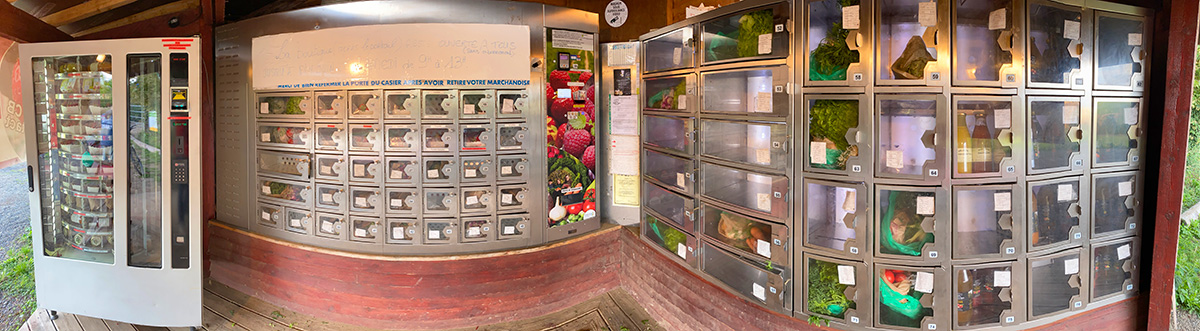
Vending machine, automat at the Ferme du Clos d’Ancoigny, St Nom la Breteche
How to choose your French strawberries
Generally speaking, the collars and stems should be uniformly green, and the fruit shiny and free of blemishes. The intensity of color, size, or shape of strawberries specific to each variety are not reliable selection criteria. A universal and instinctive indicator: the aroma!
Storing fresh French strawberries
Strawberries are fragile fruits, so eat them as soon as you get home (or in the parking lot like we do)! They can be stored for up to 48 hours in their unopened tray in the vegetable drawer of your refrigerator. They are much tastier if at room temperature.
How to eat strawberries?
Once unwrapped, rinse under cold water, then gently hull them with the tip of a knife or eat them with the stem. Leave the strawberries whole or cut them as desired.
They can be eaten in many, many different ways:
- Plain, with sugar, whipped cream, fromage blanc, cream, plain yogurt, vanilla ice cream, mint or dill leaves, or even green peppercorns.
- In salads, alone or with other fruits or savory ingredients.
- In blended, liquid, or frozen forms: juices, soups, smoothies, flans, mousses, sorbets, ice creams, etc.
- In many pastries: tarts, tiramisu, charlottes, Bavarian creams, verrines, etc.
They also can be cooked :
- At a low temperature: 10 to 15 minutes in a saucepan for compotes and coulis, 25 minutes in a jam pot for jams, and 5 minutes for jellies.
- In the oven: 5 minutes at 240°C, covered with puff pastry, fritter dough, brick pastry, or wrapped in parchment paper.
- In a pan: quickly tossing and turning over a base of butter or olive oil. Pair them with asparagus or orthigales or on a spinach salad.
The origin of French strawberries?
Today’s French strawberries are not descended from wild strawberries, which gradually acclimatized to the vegetable gardens of the Middle Ages and the Renaissance. They are the result of a cross between Chilean strawberries and North American strawberries made in 1713 by Mr. Frézier, a naval officer, whose name explains the word “fraise”! The Connexion tells the story well. https://www.connexionfrance.com/magazine/la-fraise-the-strange-history-of-frances-strawberry-family/156879 The Scottish name Frazer also comes from the same lineage.
One last tidbit:
In botany, the strawberry is called a « false fruit. » It is the achenes, the small yellow seeds on the strawberry, that constitute the true fruit.
Idiomatic expressions and proverbs:
- Comme la fraise a goût de fraise, la vie a goût de bonheur.
- Ramener sa fraise – To butt into a conversation
- Aller aux fraises – To seek out a quiet spot. The strawberry became a symbol of the pleasures of love. In the 18th century, women’s nipples were called « strawberries, » which led to this expression.
- Être aux fraises – To be lost in the clouds