


A visit to the recycling facility
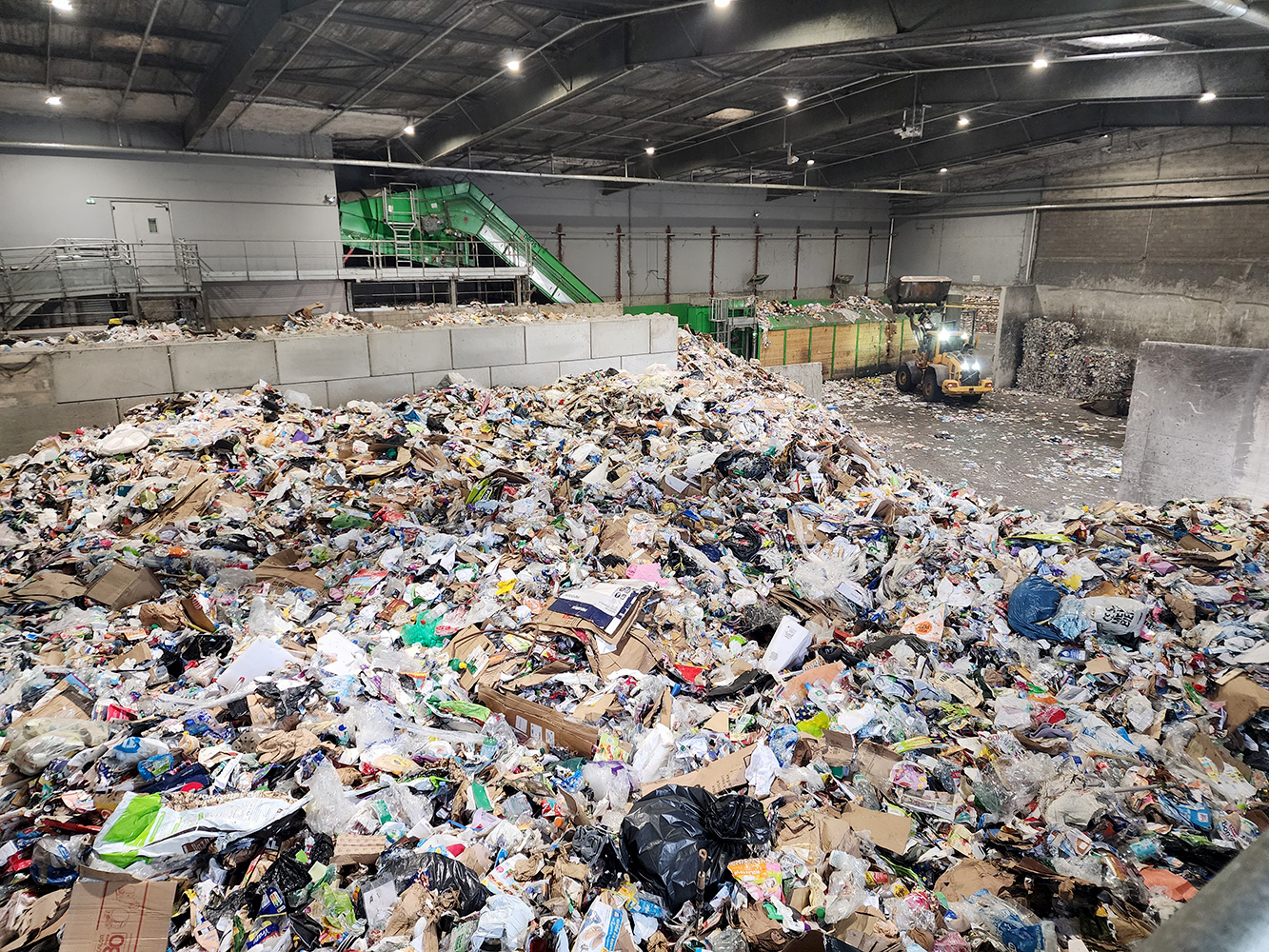
Recently we visited the trash recycling sorting center near our home just outside Paris and were fascinated by the machinery and process of treating trash as well as the value in recycling. At the same time seeing all that we throw away in one place was disheartening. We learned quite a lot about the process, how it works, who pays for it, the value of it.
Perhaps you heard in the news in April that a recycling plant in Paris 17th burned to the ground. The destroyed plant, dated only from 2019. And fire is a constant threat in the trash business. The cause of this particular fire is still not known but it could have been due to poor sorting.
For example be careful not to put batteries in the recycling or trash can. They can explode and cause fires in the collection trucks and at the plants. Other fire causing items include canisters with a gas. Such as empty Soda Stream cylinders or small butane canisters. The most frequent offenders however are the large and small cartridges of gas for making whipped cream which contain nitrous oxide aka laughing gas. (By the way inhaling this product, which is very popular amongst adolescents, might be fun but it can cause serious short and long term health issues. ). All these gas containers need to be taken to the waste collection points rather than put in the trash or recycling. Aerosols, however, can be recycled but make sure they are empty.

Financially speaking, the value in recycling
The recycling entity in our are is SIDOMPE (Syndicat Intercommunal pour la Destruction des Ordures Ménagères et la Production d’Energie). Each community sends their recycling to the SIDOMPE which has engaged two private companies to do the work. Each truck is weighed when it arrives so that the community is billed by the ton. You pay for this via your local taxes. The SIDOMPE sorts all these materials and packs them into bales then sends them out to the actual recyclers somewhere in France. There’s value in those bales and the recycler pays for these raw materials from which they will make new items. The SIDOMPE, therefore sells your recycling and then gives credit back to your community. So the better we recycle, the more we recycle, the more can be sold to the recycler and less it should cost us.
Household garbage that cannot be recycled in our area of France is incinerated. The incineration plant, right next door, burns the garbage at 800 to 1000° C from which it makes electric and thermal energy. The plants are self-sufficient in electricity using what they make to run the plant. Anything additional is sold to the electric companies. The plant near our home also heats 7500 households. The inefficiencies happen when the trash burners have to be shut down. They need to be maintained about once a year however they are stopped about once a month. Why do they stop ? Because something that has been put in the trash has caused a fire. Once again batteries or nitrous oxide cartridges are the most frequent culprits. The other thing that might stop the works is an object that blocks the entrance chute to the oven such as a bathtub or a motorcycle that has been put into a construction waste bin and thus finds itself into the household trash. Stopping the ovens to clean out the sorting errors is expensive. Each work stoppage costs about €100,000. So keeping certain items out of the household trash is also important.
Properly sorting our waste and doing it the best we can will keep the costs as low as possible. In fact I feel a little better about the trash I produce knowing that they make electricity from it. We need power and have to make it somehow. Any kind of power production is polluting but by incinerating trash we are resolving that problem at the same time. It’s certainly better than just throwing it all in a landfill. But, we have another choice to make, and that is to not make waste in the first place so choose the items you buy carefully perhaps one item has less packaging than another and don’t buy things willy-nilly that you won’t use. That is the best waste management: not to make any in the first place.

Recycling glass and plastic bottles is a no brainer
You separate your trash as you put it into the yellow recycling can, the household garbage can and the container for glass but once it reaches the recycling plant, it is sorted again more finely, using different machines, and then people do the final sorting. At the end of the process there is still quite a bit of waste. I think they said 25% that is ultimately incinerated as it was badly sorted by us to begin with and never should have gone to the sorting facility. But there are a few items that I wondered about and so I asked some specific questions of our guides. Here’s what they explained:
- You can recycle books. It’s best though to separate cardboard covers from the paper. Paper and cardboard are recycled ultimately separately because Cardboard has longer fibers, and thus becomes new cardboard. Paper has shorter fibers and thus becomes new paper. Interesting note: it is recommended to avoid wrinkling or ripping up papers.
- Some items are too small to be recycled all by themselves. This is why recent legislation made plastic bottles have the cap attached to the bottle. The objective is to keep the cap and the bottle together so that they are recycled together and we don’t end up with stray caps all over the place such as on beaches or sidewalks.
- If you have a glass bottle with a plastic cap, they need to be separated for recycling, but the plastic cap is too small to find its way through the machinery to the proper sorting. In this case It is best to keep the cap and donate it in bulk to associations who collect caps. A couple associations are Bouchons d’amour and Coeur2Bouchons.
- A big tip I learned to help my sorting was that the yellow recycling container is for packaging only. It is not meant for recycling every last bit of something plastic. If a child’s doll is made out of plastic, it is not packaging and thus when it breaks and it’s time for the trash, it goes in with the household trash. Baby diapers are not recyclable either. Even though they contain plastic, they are not packaging and they should go in with the household waste. Cassettes, video, CDs … same thing they are plastic, but they are not packaging and so they go into the household waste.
- Items put into the yellow can need to be empty, but there is no need to wash or rinse them and use water – another precious resource – to clean up your waste.
- When you’re putting things into the yellow can do not stuff the top (don’t you just love to say the French word « opercule »!) into the yogurt container before you put it into the bin. These two items end up stuck together and cannot therefore be recycled separately as they need to be. Don’t stuff your Kleenex box or any other box with items of another material. Everything goes into the bin in bulk, separately, loosely so that they fall away from each other on the giggling conveyors. Recycling items should never be bagged.
- Styrofoam can be recycled but only packaging Styrofoam. So if you buy a piece of meat on a Styrofoam tray, the tray gets recycled If you buy a new air fryer and there is shipping packaging in the box that Styrofoam can be recycled. But Styrofoam insulation cannot.
Other Things you might wonder about:
- Camembert boxes and vegetable crates are not recyclable in the yellow can and should go in the compost.
- Remove the plastic piece of a tissue box or pasta box before putting it into the yellow can. But don’t put it inside the box. Take the paper liner out of the plastic cookie package – remember no nesting of one thing inside the other.
- Blister packages such as medication go in the yellow bin. Again they need to be empty. Unused medication gets returned to the pharmacy.
- If you get a magazine or other paper item in a plastic wrapper remove it from the plastic then put both items loose into the yellow bin.
- Tissues, paper towels and diapers go in the trash. They cannot be recycled.
If you have a doubt leave it out.

A very short history of trash recycling :
In 1883, Prefect Eugène Poubelle required Parisians to place their waste in lidded containers that quickly took his name. One bin is dedicated to putrescible materials, another to old papers/rags and a last one to glass, earthenware and oyster shells. The beginning os selective sorting and the origin of the word poubelle.
The 19th century also saw the birth of rag-pickers (chiffoniers or biffins in French), the first recyclers in history. With their baskets on their backs and armed with a hook, they rummage through the trash to resell all sorts of objects: rabbit skins for glue, bones for matches or candles, cans for toys, etc.
The two World Wars force the population to systematically recycle metals to make weapons, railways or munitions.
In the 20th century contemporary artists: César compresses cars and newspapers, Christian Boltanski piles up old clothes, and Arman’s Accumulations prove that our garbage is the mirror of our private life.
Each person in France generated an average of 250 kilos of waste per year in 1960, today it is 611kilos.
The first yellow trash recycling cans date from 1992 thanks to a law which finally obliged French municipalities to recover and recycle waste, now considered to be a decisive source of energy and raw materials.
Here’s how to donate items and give them a new life.
If you live in the western suburbs of Paris you can visit the SIDOMPE. Here’s how. It’s free and the guides are very personable and knowlegeable.