


What is the European Parliament? Answer that question in our companion article.
The European Parliament Election (June 6-9 2024) is the second biggest election in the world in terms of number of voters, only India has more. The objective is to elect the 720 members of the European parliament, thus it concerns 27 countries. Since France has 81 seats, each list in France from each of the 38 parties (or lists) presenting candidates must have 81 members alternating strictly between men and women, for a total of 3078 candidates in France alone. The lists are organized vertically following their leader.
This is a proportional election. First a list must achieve at least 5% of the vote (in 2019 that was 6 lists of the 34 total). Then according to the percentage of the vote won by the party the first X% of candidates from each list will go to parliament. The French lists are required to have 81 members each just in case one list sweeps the vote and thus wins all of France’s seats (hard to imagine!).
This is the tenth European parliamentary election; terms are 5 years. Each country has a number of MEPs based on their population, but there are minimum numbers for the smaller countries so the number of seats is not exactly proportional to population. The parliament is the only EU institution directly (adult universal suffrage) elected, with the Council of the European Union and the European Council being indirectly legitimated through national elections.
Also being decided this year is the composition of the European Commission, the Executive body of Europe. This will be done by the European Council and the Parliament after the elections.
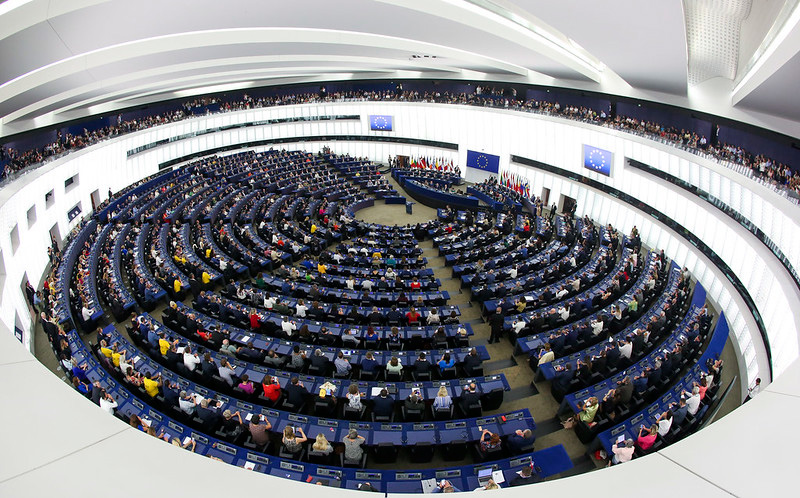
Session of the European Parliament in Strasbourg. CC-BY-4.0: © European Union 2019 – Source: EP ». (creativecommons.org/licenses/by/4.0/)
But why are so many of the official European parliament election boards blank just a few days before the vote?
First here’s a list of the lists from the classic to the more whimsical names in their official order:
- Pour une humanité souveraine
- Pour une démocratie réelle : Décidons nous-mêmes !
- La France fière, menée par Marion Maréchal et soutenue par Éric Zemmour
- La France insoumise – Union populaire
- La France revient ! Avec Jordan Bardella et Marine le Pen
- Europe Écologie
- Free Palestine
- Parti animaliste – Les animaux comptent, votre voix aussi
- Parti révolutionnaire Communistes
- Parti pirate
- Besoin d’Europe
- PACE – Parti des citoyens européens, pour l’armée européenne, pour l’Europe sociale, pour la planète !
- Équinoxe : écologie pratique et renouveau démocratique
- Écologie positive et territoires
- Liste Asselineau-Frexit, pour le pouvoir d’achat et pour la paix
- Paix et Décroissance
- Pour une autre Europe
- La droite pour faire entendre la voix de la France en Europe
- Lutte ouvrière le camp des travailleurs
- Changer l’Europe
- Nous le peuple
- Pour un monde sans frontières ni patrons, urgence révolution !
- Pour le pain, la paix, la liberté ! » présentée par le Parti des travailleurs
- L’Europe ça suffit !
- Non ! Prenons-nous en mains
- Forteresse Europe — Liste d’unité nationaliste
- Réveiller l’Europe
- Non à l’UE et à l’OTAN, communistes pour la paix et le progrès social
- Alliance rurale
- France libre
- Europe Territoires Écologie
- La ruche citoyenne
- Gauche unie pour le monde du travail soutenue par Fabien Roussel
- Défendre les enfants
- Écologie au centre
- Démocratie représentative
- Espéranto langue commune
- Liberté démocratique française
Since we are voting this coming weekend we are currently seeing the election poster boards outside the polling places. As for every election in France all parties must have a board big enough to fit one large and one small poster outside each polling station. PLUS the set of boards must have one labeled « 0 » for the administrative mumbo jumbo. The European election is quite a casse-tête for the municipalities which are obliged first to find then find space for 38 boards (or at least 19 which can be divided in two). But why are so many of the boards blank just a few days before the vote? There are 80,000 polling stations which means 80,000 boards, which means a huge printing bill for posters and then they posters need to be hung. The larger parties do this by hiring France Affichage Plus who makes the rounds to put up posters. In fact FA+ makes the rounds twice; the second trip replaces defaced posters. So the big parties are printing 157,000 posters! Using 6 tons of paper… each. With limited budgets the smaller parties must make choices and rely on party members to do the posting.

This is 2019. It was tough to take a photo of all 35 boards.
Another way the parties spend money is on the mission statement leaflet that is mailed to every voter. Again a huge printing bill forces choices. Previously the Animal Party chose the more publicly visible posters (How can you you not see that cute beagle, kitten, duckling or bunny with a bulletin in his mouth!?) as opposed to the mailed leaflet. But their budget has increased and profession de foi you will receive in 2024. If this term sounds religious, it is. It is the same phrase used for confirmation in the church. It simply means however to make an open and public declaration of one’s beliefs. The Ecology Emergency party has chose posters over printing ballots – because even ballot printing is at the expense of the party.

The « 0 » panel which displays the administrative mumbo jumbo about the election.
To resolve this French exception, a bill was presented at the end of March 2019 to the French parliament to eliminate the individual paper ballot and switch to a one sheet ballot (printed and financed by the government) where the voter will check off their choice. But alas this isdea which is the norm in many other European countries was not passed. It is much less expensive for the political parties, the government and the environment. What’s not to like? Perhaps the next thing to change will be the poster boards. Eliminating them will also save a lot of paper and expense. The boards were instituted along with universal suffrage and thus before radio, TV and internet become the main means of communication. Historically the boards were papered with the party platform, not photos of the candidates or puppy dogs. Are they a thing of the past? Are they still effective? One more thing to take up in parliament.

European Parliament in Strasbourg. CC-BY-4.0: © European Union 2020 – Source: EP ». (creativecommons.org/licenses/by/4.0/)
PS: Election envelopes are financed by the government but manufactured by private shops. These envelopes have no glue to close them, a pointed flap, and are made out of colored recycled paper. They come in 16 colors which are varied at each election. For this European election 2019 we’ll be voting with blue envelopes. Each polling station puts out only the exact number of envelopes as voters on their list.
PS2: We often hear the word scrutin used during French elections. This word comes from Latin and means “to examine” and refers to placing votes in a box watched over by scrutateurs where they become anonymous.

Board #31 – The beagle representing the Animal Party in 2019 and 2024