


Laughter is the best medicine they say. According to scientists, we laugh an average of 18 times a day. Laughter is therefore an important part of our everyday lives and even the French know how to rire. Here’s a few reflections on laughter in France, the land of La Vache qui rit! By the way, La Vache, a French institution, (She was 100 years old in 2021) has her own maison and museum in Lons-le-Saunier.

Première-affiche-par-B.Rabier,-1924,-Maison-de-la-Vache-qui-Rit.-©-MVQR
The city of Bordeaux seems to be the center of laughter in France
One might say Bordeaux likes to laugh more than elsewhere in France (is it because Bordeaux is also the rainiest city in France?). The city is host to the Festival Les Fous Rires de Bordeaux in March each year http://lesfousriresdebordeaux.fr/. The city also presented an exhibition called « Rire! » in 2019 at their science and nature Muséum. But Bordeaux doesn’t own the market there are many other spots are also holding annual festivals and for some funny reason most are in March!
- Festival de l’Humour 2026(Vendée)
- Le Printemps du Rire in Toulouse March/April https://leprintempsdurire.com/
- Drolement Bien (January) in Besançon https://drolementbien.fr/
- Les Vendanges de l’humour (November) in Mâcon en Sud-Bourgogne. https://lesvendanges-de-lhumour.com/
French town names that will make and English-speaker snicker: Félines, Linge, Facture, Le Barp, Bitche, Les Cars, Brainville, Contest, Le Sap, Stains, Dangers, Brest, Condom, Anus, Ars, Seix, Tendon, Hompes, Bard, Nevers, Grouchy, Le Bugue, Saint-Hilaire-ious!
And these town names even make the French laugh: Plaisir, Trécon, Verdelais, Arnac-La-Poste, Corps-Nuds, Bidon, Marans!
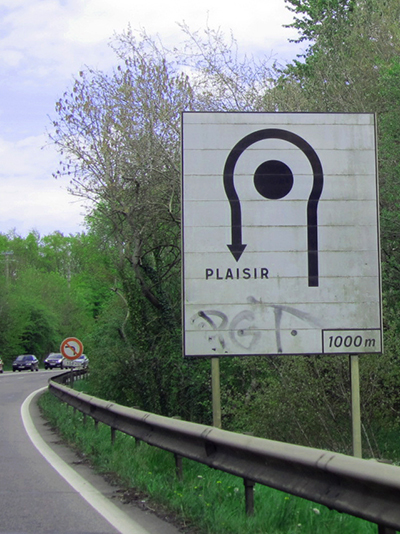
This is a real road sign in the Yvelines department!
A collection of quotes about gallic humor
Two of the American humorists who find favori n France are Jerry Lewis and Peter Falk as Colombo. Haven’t you noticed how many Colombo episodes are on TV each week? This article, originally published in Loofe: Light and Lively Observations On France Extraordinaire, offers a collection of quotes about gallic humor by various authors followed by another cluster, this one of memorable zingers from noted French humorists.
One of the answers to the question “What makes a Frenchman laugh?” is his fellow-countrymen. The French find themselves even more funny than foreigners do. But France is composed of a large number of small republics at war with each other, using laughter of different kinds as weaponry. The foreigner first begins to feel at home in France when he can identify with one of the temperaments that give these small republics their cohesion, and with one of the battles that they get so much fun out of waging. Theodore Zeldin « The French »
One of the failings of the French society today is the tyranny of the little snickering laughter (la tyrannie du ricanement). Frédéric Beigbeder « L’homme qui pleure de rire »
Very few French people have the ability to burst out laughing… A French person laughing typically resembles a person smiling while having a short outbreak of hiccups… Consequently, many foreigners view the French as cold. But the truth is, they are simply well trained. Olivier Magny « What the French »
There are ways to express your joy in life; However don’t guffaw, don’t burst out laughing, don’t laugh loudly in society, in a restaurant, in the street. Ghislaine Andreani « Guide du Nouveau Savoir -Vivre »
(…) il se mit à rire à gorge déployée comme si nous avions été seuls dans un salon. Marcel Proust « À la recherche du temps perdu – Le temps retrouvé », 1927
Spoonerisms (les contrepèteries) in France are considered one of the Beaux-Arts. Joël Martin « Manuel de Contrepet »
Reminder : A spoonerism is a lapsus linguae in which corresponding consonants, vowels, or morphemes are switched between two words in a phrase. These are named after the Oxford ordained minister William Archibald Spooner, who reputedly did this. An example is saying «A well-boiled icicle» instead of «a well-oiled bicycle». While spoonerisms are commonly heard as slips of the tongue, and getting one’s words in a tangle, they can also be used intentionally as a play on words. Now that you understand spoonerisms move on to French contrepèteries. (Warning many are rather saucy.) A couple of examples to get the ball rolling: Glissons dans la piscine… Avez-vous entendu parler de la chronique des mille-pattes? And a well-known one from Rabelais — Elle est folle de la messe.
If the pun is so present, it’s because it is related to the sound of our language. French is extremely rich in terms of homophones. Laurent Gaulet
The French aren’t known for being hilarious. When I told Parisians I was interested in French humor, they’d say ‘French what?’ (humour is hard to pronounce; try saying eww-moour). Then they’d ask, ‘Does that exist?’ They were joking, of course. Pamela Druckerman
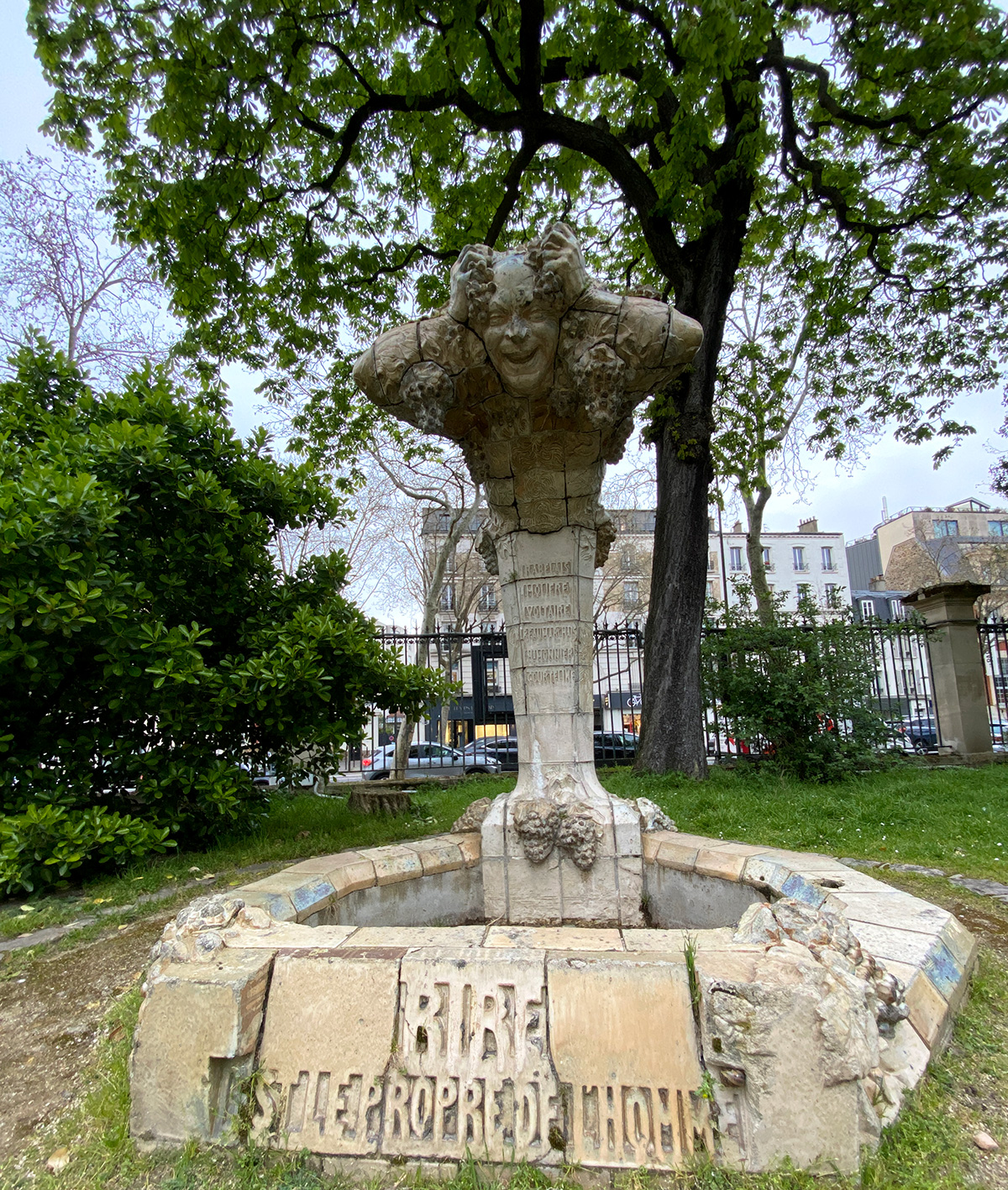
« RIRE EST LE PROPRE DE L’HOMME » dédié à Charles Armand Ménard dit Dranem (1869 – 1935) was a Parisian fanciful, extravagent, imaginative singer at the the café-concerts. Considered the father of the genre of the silly and mischievous comedian, the « emperor of laughter » and favorite French comedian of the Belle Epoque created numerous music hall revues and operettas. His humor was often incongruous and salacious. He played several roles in the cinema and was the founder of the retirement home for performing artists in Ris-Orangis. This sculpture (a disused fountain) from 1925 by Paul Moreau-Vauthier is in the Parc Leon Blum in Boulogne-Billancourt.
How to sound like funny François or hillarious Héloïse?
Learn a few of these well-known quips from famous French humorists and sprinkle them generously into your tricolor conversations. Eww-moour guaranteed.
- Pierre Dac 1893 – 1975
- Souffrant d’insomnie, j’échangerais un matelas de plumes contre un sommeil de plomb.
- C’est fatigant de voir les autres se reposer.
- Coluche 1944-1986:
- Je suis capable du meilleur et du pire. Mais, dans le pire, c’est moi le meilleur.
- La victoire est brillante, l’échec est mat!
- Athée pieds. Voilà ma religion. Elie Semoun
- Leonardo Di caprio c’est l’anagramme de Blanche Gardin…. Ah non, pas du tout. Par contre «Carpe Diem» c’est l’anagramme de «ça déprime» Blanche Gardin
- Moi je suis jamais pompette je suis toujours bourrée! Florence Foresti
- J’adore vieillir. Pour rien au monde, je ne voudrais revenir en arrière. C’est tellement mieux, on est moins con… Muriel Robin
- En banlieue, soit tu as la force soit tu as la tchache. Jamel Debbouze
- Internet. On ne sait pas ce qu’on y cherche mais on trouve tout ce qu’on ne cherche pas. Anne Roumanoff
- L’imaginaire met des robes longues à nos idées courtes. Sim 1926 – 2009
- Laurent Baffie, 500 questions que personne ne se pose
- Une éphémère peut-elle procrastiner ?
- Y a-t-il des ours bipolaires?
- Doit-on donner du pain perdu à un enfant trouvé?
- Qui prête à rire n’est jamais sûr d’être remboursé. Raymond Devos 1922 – 2006
- « Mieulx est de ris que de larmes escripre, Pour ce que rire est le propre de l’homme », (sic) François Rabelais, Gargantua (1534).
Since our used book shop, Bill & Rosa’s, has a connection with the American West here’s a wonderful article about cowboy humor which is « a little bit philosophy, a little bit survival, and a whole lot of telling the story of how a day went wrong in a way that makes it sound like you meant it to happen that way. »
The Quiet Art of Cowboy Humor: How Western Wit and Poetry Shape Ranch Storytelling
